Showing posts with label Ants. Show all posts

Wednesday, 4 June 2014

Brown scale insect

A garden ant stimulated this scale insect to produce honeydew with her antenae. Some these scale insects, Parthenolecanium corni, are growing on a grapevine branch, just under strips of bark. They are about 5 mm, dark and shiny, with ridges across. When young, they are tiny and mobile and are called crawlers, and live under leaves. When they are ready to moult into the immobile scale stage they move into branches. Scale insects, as aphids, suck the sap of plants, and excrete a sugar rich liquid call honeydew, which ants like.


 These scale insects can become a pest of various fruit trees. The scale insect has natural enemies, though. Parasitoid wasps inject their eggs into the scale insect, and the larvae will emerge though holes in the scale, instead of the crawlers. A parasitised scale insect after the wasps emergence is shown below.
26/12/2011

Thursday, 8 August 2013

Catching the wind

The last couple of weeks have witnessed increased activity of garden ants. It is the season when winged ants (males and queens) take to the air forming swarms. Today I noticed groups of queens emerging from a nest in the garden. The queens climbed over the plants, warmed up their wing muscles and took to the air. They often land straight away unless they can get high enough and ride the breeze. This was that this winged ant was doing, with head and antennae outstretched, it checked if it was the right time to fly. The dark clouds in the background are also typical of flying ant days, as the prefer stormy, warm weather to emerge.
The lucky ones will mate in the air and come back to the ground, lose their wings and find a suitable site to start a nest. Many will perish though, eaten by birds or spiders.
 If you notice flying ants where you live, you can submit your record to the Flying Ant Survey, organised by the Society of Biology. It only needs a couple of minutes to fill the form.

Wednesday, 26 June 2013

Elder aphid networks

The photo above shows a dense colony of Elder aphids, Aphis sambuci, many individuals of different ages feeding close together. They are likely to be all a clone, female descendants of a single founding female that emerged from an egg early in spring, and identical genetic copies of her. Elder aphids forms this characteristic ash grey patches on tender elder stems. The aphids suck the elder sap using their piercing mouthparts. Having a close look at elder aphids gives you an opportunity to learn to learn about ecological networks in a few minutes of observation. All the photos in this post were taken in the space of seven minutes this morning on my way to work on the same young elder bush.
 Despite the fact that elder, Sambucus nigra, has relatively few insect predators, most likely due to it having cyanogenic chemicals in its leaves, elder aphids are an important link in networks making use of elder sap. 
Ants have a mutualistic relationship with the aphids. They benefit from the aphids honeydew by soliciting them to excrete it, taping them with their antennae. The sugary rich liquid is consumed by the ants and their larvae. The ants treat the aphids as their domestic animals. The aphids benefit too, as potential predators or parasites are pursued or attacked by the ants.
But the ants can't totally defend the aphids from their numerous predators. Here a female hoverfly, Epistrophe eligans, lays eggs on a patch of elder aphids.
A hoverfly egg is visible on the centre of this photo, on the edge of the aphid colony.
See the patches cleared of aphids in this patch? They are due to predation by the green hoverfly larvae just visible amongst them. Surrounded by food, the larvae will gorge on the aphids and grow rapidly.
This hoverfly larvae (possibly Epistrophe eligans) is likely to be ready to pupate.
Not only hoverflies, ladybirds are attracted by this aphid bonanza and adults land on the elder, possibly attracted by the smell of aphids. A Harlequin sunnies itself on a leaf...
...while an active 2 spot searches about.
Ladybirds have laid their bright yellow egg clutches on or under the leaves, near the aphid colonies.
...here visible on the background. I couldn't find any ladybird larvae today on this elder. 
This fly enjoyed licking the honeydew on a leaf. Some species of butterflies, like the Speckled Wood, also takes advantage of honeydew.

Five species (2 ladybirds, a fly, an ant and a hoverfly) thriving on elder aphids. If I had waited a bit longer, or being a bit luckier, I could have witnessed tiny parasitoid wasps that lay their eggs inside the aphids and eat them from the inside!

Thursday, 20 June 2013

Ants and cherry laurel nectaries

 On passing by a hedge of Cherry Laurel, Prunus laurocerasus, we notice ants. Lots of Black Garden Ants, Lasius niger, walking all over the leaves. We creep closer and see little round marks on the base of the leaves that the ants are paying special attention to. They are nectaries, nectar producing organs in plants, which are most commonly found at the base of flowers. In about 1% of plants (including several species of the genus Prunus, including cherries) these organs are also found on leaves and are called 'extrafloral nectaries'. Extrafloral nectaries are part of a mutualistic relationship between plants and ants, in which both parts benefit. The plants give away the sweet nectar which feeds the ant, and in turn the ant defends the plant. By visiting the plant to obtain nectar ants come across herbivorous insects, particularly caterpillars, that might feed on the leaves, and prey upon them.
 Other nectar-loving insects take advantage from this easy to reach nectar production, and often, bees and bumblebees are found feeding in nectaries. Bees and bumblebees behave in this case as 'nectar robbers' as they do not benefit the plant at all (unlike when they feed on the floral nectaries). In this case, the ant is the one benefiting the plant. If you like the bright green, glossy leaves of the cherry laurel to stay that way, you might want to leave these ants well alone.
Ant feeding on a nectary. There is another pale, round nectary just above the ant.
Male Bombus pratorum visiting the cherry laurel

Saturday, 27 April 2013

Red Ant nest

We found this Red Ant, Myrmica sp., nest under a stone. The chamber in the middle of the photo had many workers tending larvae, and what appeared to be a queen, a bit larger with darker head on the top left corner. With the ants, there were a few Cyphoderus albinus, a species of white springtail which is often found inside ants nests. There were also many millipedes, thread-like, blind, with red spots, Blaniulus guttulatus.
Blaniulus guttulatus millipede
White springtails, millipedes, red ands and a slug

Saturday, 15 September 2012

Are male false widow spiders ant mimics?

An adult male Common False Widow spider, Steatoda bipunctata, barely half a cm in size, scuttled across the kitchen floor yesterday, most likely in search of receptive females. As most spiders, males look quite different from females, but these do look peculiar due to their very large palps, which they carry together while they walk. It immediately reminded me of a garden ant. I googled 'ant mimic Steatoda' and got nowhere, and my reference books also drew a blank, although they noted the relatively large male palps. How can you tell if a spider is an ant mimic (a myrmecomorph)? Sometimes it is so hard to tell them apart the myrmecomorph even tricks ants themselves - which the spider can then predate easily. Other myrmecomorphs are content to trick birds or other common spider predators which find ants distasteful, and the resemblance then might not be so striking on close inspection. There are several recognised ant-mimic spiders in the UK, which are likely to have evolved to resemble the ubiquitous garden ant Lasius niger, a small (4-5 mm), dark brown to black ant (see previous post on Micaria pulicaria). In that post I referred to a list of morphological features that ant-mimics are likely to have evolved, devised by Paula Cushing, so I can check if my candidate ant mimic male Steatoda bipunctata meets them:

1. Body shape: three body segments. Spiders have two body segments so ant-mimics must evoke the three body segments of an ant (head, thorax, abdomen) The large palps of male Steatoda bipunctata, carried raised and together, appear to make the role of an 'ant head'. Check!
2. Three pairs of legs and one pair of antennae. I need to carry more observations on live individuals to assess how the front legs are carried, as ant mimics carry them forward and often raised.
3. Petiole or 'waist' of the ant. My spider has a strong constriction at the end of the cephalothorax reminiscent of the 'waist' between the thorax and the abdomen of the ant. Check!
4. Mandibles. Pointed palps, but not an obvious feafure of Lasius niger.
5. Pair of compound eyes. No clearly mimicked, but also not a very distinctive feature of L. niger.
6. Sting. Not normally visible in Lasius niger.
7. Thin body and legs. Check!
8. Shiny surface. Very shiny, waxy looking. Check!
9. Segmented abdomen.  Abdomen with bands that reflect light as the tergites in an ant abdomen, with a similar pubescence. Check!

Not bad, a clear 5 out of 9 ant-mimic features clearly by this species, and I must add that something missing from the list are the general size and colour, which in this case also fit the garden ant. That the male does resemble an ant more than the female could be explained by the fact that he is likely to be exposed to predation while he moves in search of females - who sit on their webs and would be unlikely to gain much from resembling an ant.
What do you think? 
Ant Lasius niger tending aphid
Top view of male Steatoda bipunctata

Saturday, 8 September 2012

Queens and kings on the wing!

We've enjoyed a whole week of warm weather and no rain. Today, garden ant queen, Lasius niger,  that had already lost its wings, was running on the pavement, and on my local wildlife garden, nervous workers on the path made me look closer. When new winged queens and male ants are ready to emerge, workers follow them run frantically about. And emerging they were, for at least the third time this year, many queens and smaller numbers of male ants. Some queens were trying, unsuccessfully to fly straight from the ground, others, like the one above, reached for a higher point, to get a better chance to take to the wing.
Winged ant queen, Lasius niger, revving its wings on the ground
The couple of queens above started climbing a fence post while the workers followed them. Although many winged ants will eventually take to the sky, where they find their mates, a Zygiella x-notata web hung with entangled winged ants on top of this fence post. That spider is going to have a super dinner tonight.
 I have never seen flying ants this late in the year, have you seen any winged ants recently? The Society of Biology is carrying out a Flying ant Survey, where you can submit your records.

Thursday, 21 July 2011

Ants tending aphids

Ants have a sweet tooth. They gather nectar from flowers, buds and nectaries but also farm animals to obtain their sweet honeydew. These farmed animals are scale insects and aphids. Ants tend the aphids (above), protect them from their predators and parasites and keep them together for easy "milking". To obtain the honeydew produced by aphids, ants stimulate them with their antennae, after which the aphid will secrete a droplet of sugar rich liquid. These ants are tending groups of aphids on an Iris leaf. To soften the built-in flash light I put a piece of kitchen paper in front of it, holding it with my left finger.

Saturday, 16 July 2011

Birds and ant swarms

In July and August, typically in sunny days after rains, swarms of reproductive Black Garden Ants (Lasius niger) - winged queens and males - emerge from their nest to mate and start new colonies. Workers also come out en masse and run around the entrance of the nest, looking agitated. I had often noticed this and wondered why do workers did this, until yesterday, watching a Blackbird feeding on the winged ants coming out of their nests, realised why. The Blackbird run close to the entrance, fetched a winged ant and run away. The bird repeated this several times and was obviously being stung or sprayed by the ants around the nest, but still wanted to feed and its back-and-fro behaviour was evidence of the - at least partial - success of the frantic workers keeping predators at bay. Winged ant have many predators. Some casually feeding on the winged ones, others opportunistically making use of a plentiful, although ephemeral, bonanza. A range of birds fall in the latter category, starlings and sparrows feed on the winged ants - sometimes using fly-catcher techniques - and seagulls have been seen feeding on them up in the sky. While reading a paper on this, I remembered that last year, on the day the ants emerged, I looked up in the sky and saw many small flying things and thought they might be the flying ants. When I looked more closely I saw they were seagulls, and was surprised at how many there were, well over a hundred, soaring very high up. I took a shot (below) and forgot about it. They were most likely feeding on the winged ants that had been carried high by thermals in their swarming mating flight.
Seagull flock feeding on swarming ants (26/07/10)
This is the nest in the bottom right hand corner of the top photo
Workers around a nest with winged ants emerging (26/07/10)

Reference
James Baird and Andrew J. Meyerriecks (1965). Birds Feeding on an Ant Mating Swarm. The Wilson Bulletin, 77 (1), 89-91.
Gilbert S. Grant (1992) Opportunistic Foraging on Swarming Ants by Gulls, Shorebirds, and Grackles. The Chat, 56, 80-82.

Saturday, 9 April 2011

A spider in ant disguise

ResearchBlogging.orgMy young daughter does not like ants. This is a bit troublesome at this time of the year when garden ants are everyhwere. Yesterday, she pointed at something on the ground. I looked at I saw what looked like an ant carrying another ant running very fast. It must have looked a bit odd as I stopped the "ant" putting my hand in front of it. She hid underneath and I slowly lifted my hand and took a couple of shots. Only when revising the shots did I realised that the ant was only an illusion: it was a spider, but one that strongly resembles an ant not only in size, general shape, shininess, but also in posture and behaviour. She carried her front legs raised so that it looks like its got antennae and six legs, and its movements were most reminiscent of the manic running of ants in hot weather.
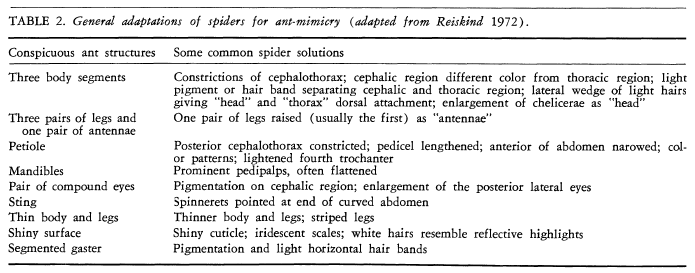
In her review of ant mimicry in spiders Paula Cushing stated referring to morphological spider modifications to resemble ants:

They include a variety of color and body-form modifications that give the spider the appearance of having three body segments instead of two and of having long, narrow legs instead of shorter, more robust legs. Mandibles, compound eyes and even stings are sometimes mimicked by the spiders through modifications in the chelicerae, pigmentation in the cuticle, or special positioning of the spinnerets. In many cases, the extent to which the mimics resemble a particular model is extraordinary
The following table helps in dispelling the notion that this ant resemblance is just a fantasy of the observer.
There are many species of invertebrates that have evolved to resemble ants including crickets, bugs, beetles, springtails, and even flies. At least 100 species of spiders of 12 families mimic ants. The formal name for this phenomenon is ant mimicry or myrmecomorphy. But why would a spider evolve to look like an ant? A few spiders resembles ants in order to get close to them and eat them (aggressive mimicry), but most ant mimic spiders benefit because visual predators take them for ants, and avoid eating them. This is a case of protective or Batesian mimicry, the mimic imitating a dangerous model. Ants can be distasteful or aggressive or both, with biting jaws, a spray of formic acid and a sting. Given that the deception is visual the selective agent must be highly visual: birds, wasps, hunter spiders that normally avoid ants would avoid an ant mimic in the same way, therefore a small spider may have much to gain from resembling a common local ant. My little ant-spider is most likely Micaria pulicaria, a widespread species in the U.K. often found running in the company of common garden ants. It is not reported that it preys on ants so, the reason for its ant mimicry, most likely involves Batesian mimicry. Interestingly, it is the only diurnal genus in a mostly nocturnal hunter spider family - Gnaphosidae, for an example see this post - and ant mimicry might have help this spider lineage conquer and diversify in a diurnal niche.

References
Cushing, P. (1997). Myrmecomorphy and Myrmecophily in Spiders: A Review. The Florida Entomologist, 80 (2) DOI: 10.2307/3495552
Reiskind, J. (1977). Ant-Mimicry in Panamanian Clubionid and Salticid Spiders. (Araneae: Clubionidae, Salticidae) Biotropica, 9 (1) DOI: 10.2307/2387854

Tuesday, 27 July 2010

Queen ant makes spider dinner

I have come across queen garden ants (Lasius niger) for a week. The first one, a wingless one wandering on the garden checking every little crack on the cement eager to start digging her nest. She was quick and the light conditions weren't ideal, so, reluctantly, I moved her to a white bowl for a portrait (above). Yesterday, queens and males were emerging en masses from nests on the side of the street pavements in the afternoon, ready to start their nuptial flights.
The males are similar in size to workers, the queens, double their size and with a much larger abdomen.
Male garden ant
 I even got a mating pair, with the female dragging the male about and both flying away:
Mating ants (the male's antenna can be seen on the right hand side of the queen)
The queen ants will usually mate once in this flight and then land and dig their nests and live underground the rest of their long lives, the males will die shortly after. I say the queens, but I should have said the lucky queens. Most of them will actually die before they hit the ground again, eaten by swifts, swallows, gulls or sparrows. Others will contribute to a spider bonanza. Hundreds of aphids and some ants could be seen yesterday and today covering the webs of the missing sector spider (Zygiella x-notata) on railings. One queen wandered on my conservatory wall and fell on the disorganised cobweb of a Steatoda bipunctata spider, who quickly approached the ant (maybe biting it?) and retreated to the corner of its web. A few minutes later the queen had stopped struggling, and the spider came out for his dinner.
Steatoda bipunctata with dinner
The spider drags the queen ant to its retreat (notice the screw head for scale).

Monday, 14 June 2010

Ants as scavengers and herders

So far I have overlooked two important aspects of garden ant foraging behaviour, mainly due to the lack of suitable photos. Yesterday, I spotted a strange large insect walking on the concrete yesterday, when I got closer I realised it was actually a dead bluebottle being dragged by a garden ant (Lasius niger). Another ant run frantically back and forth, but a single one seemed to do most of the work. The strength of an ant is quite formidable, able to lift or drag objects much heavier than themselves. This illustrates the role of ants as scavengers. Any dead animal will either be dragged to the nest or bits of it will.
The second aspect is one of the most surprising of ants - showing their adaptability -  but also a reason why they are hated by many gardeners: their role as aphid herders. Ants behave as farmers with their aphids and will try to keep the numerous aphid predators at bay as well as milking their honeydew. This is considered a mutualistic relationship and aphids also benefit from the behaviour. Even when aphid predators are excluded, aphids multiply faster in the presence of ants. The photo, taken today, shows two garden ants stimulating Elder Aphids (Aphis sambuci) to excrete their honeydew. Elder aphids form very compact groups on tender growing stems of Elder.

Saturday, 15 May 2010

Ants helping plants: extrafloral nectaries

ResearchBlogging.orgIn the last couple of weeks I have posted about ants affecting plants negatively one way or another: taking nectar from flowers but failing to fertilise the plant; farming scale insects and defending them from their predators. Ants, however, also have mutualistic relationship with plants. Take cherry trees. As their green cherries are growing, their young, tender leaves are at their juiciest. Many caterpillars and other herbivorous insects would love to have a go at them. But cherries have a sweet way to call for bodyguards: they secrete nectar in red floral glands at the base of each leaf - also called extrafloral nectaries. These are irresistible to black garden ants (Lasius niger) (above) and they secrete nectar in small quantities so they encourage ants to scout around the tree to find the next leaf. Should they encounter a caterpillar trying to get to the leave, or an insect land on it, the ants act aggressively like they would do to defend aphids or scale insects, and keep the insects at bay. Nectaries are produced by a large diversity of flowering plants and experiments have demonstrated that if ants are excluded from a nectary bearing plant, the plant is rapidly damaged by herbivorous insects. In the American black cherry, nectar production in nectaries is seasonal and it is precisely timed to the period when tent caterpillars are small enough to be able to be predated by an ant. When ants are disturbed by an insect, they immediately attacked the insect and if small, they carried it back to their nest. This seasonal match between nectar production and caterpillar attack suggests that the main function of nectaries is ant attraction, as a deterrent from herbivorous caterpillars.
An ant inspecting the nectary, a glistening drop of nectar in the middle of it. Smaller nectaries are also present at the end of each serration in young leaves.
Two ant on nectaries.

More information
Tilman, D. (1978). Cherries, Ants and Tent Caterpillars: Timing of Nectar Production in Relation in Relation to Susceptibility of Catepillars to Ant Predation Ecology, 59 (4) DOI: 10.2307/1938771

Wednesday, 12 May 2010

Ants score again

Frustrated by not getting the shot of the Bombus terrestris queen chewing the comfrey flowers the other day, I check the comfrey quite often. I am surprised - OK, not much I must say - by an ant (Lasius niger) walking on the flowers and entering them using the convenient hole made by the bumblebee queen. So, ants are also secondary nectar robbers!
Ant peeks into the hole
Getting in
and she is in sucking the lovely sweet nectar...

Wednesday, 28 April 2010

Ant vs. ladybird

I illustrated in yesterday's post than ants tend scale insects for their honeydew. My orange trees have many scale insects and numerous ants tirelessly tending them. Ladybirds like scale insects too, but for entirely different reasons. Yesterday, I took some photos of a 7-spot ladybird munching on scale insects. Ants, of course, do not like this, and today I managed to witness an ant (or ants) attacking a 7 spot ladybird. The ant was very persistent. It was quite windy, and in several occasions, the ant was blown away only to return to the ladybird a little later. To my eyes, the ladybird defence was passive, she tucked her legs under her body and didn't move much, relying on its shiny and slippery elythra for protection. The ant had her jaws wide open and her abdomen often curved underneath its body, as if it was spraying the ladybird with formic acid. She went for the gap between the thorax and abdomen in several occasions, trying to get a place to bite. After the struggle, the ladybird remained in the tree. There was a Harlequin ladybird on the same tree near some scale insects and I will keep a watchful eye for ant attacks on her too. It was quite challenging to get shots with the wind and the ladybird being in between the foliage, but a series follows.
If you click on this photo you might see the wide open jaws of the ant
Looking for a weak spot
From the back
Curled up abdomen
Looking for the ladybird legs
Harlequin and scale insects