Showing posts with label cleptoparasitism. Show all posts

Friday, 10 July 2015

A cleptoparasite in the bee hotel


The Red Mason bee is well over in the garden. They have been replaced by their smaller relatives, Osmia leaiana. They have started nesting in the bee hotel and there are several females stocking their nests with nectar and pollen and sealing their nests with chewed up leaves. I removed the side panel of the nest box temporarily to see the progress of the nests. Below is a female with a clump of chewed leaves starting another cell. The yellow lumps are the food supply necessary to nurture one of her larvae to develop into an adult bee.  The bee needs many pollen collecting trips to complete a cell, and then many other trips to collect the leaves to build the cell that will seal each of her nests compartments.
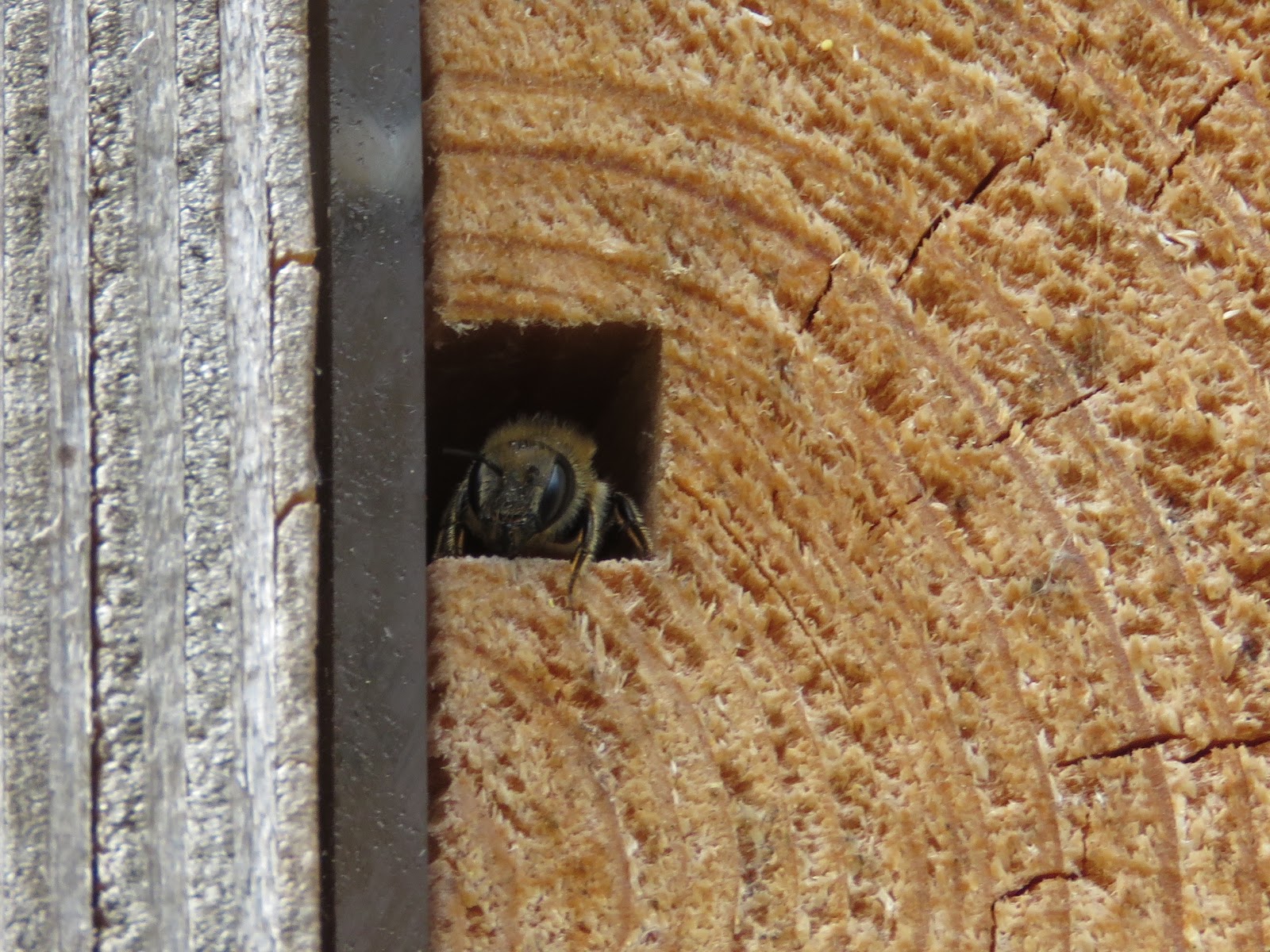
Well, that's the mason bee's plan. However, there are other bees and wasps with their own intentions regarding these laboriously collected clumps of pollen and nectar: they are cleptoparasites. They will take advantage of a female bee outing in search of flowers, enter the nest and lay an egg next to the bees egg. The cleptoparasite egg either hatches earlier, or the parasite larva kill the bee larva to have the food to itself. One of these cleptoparasites is the wasp Sapyga quinquepunctata (above), a black, thin, long wasp with iridescent blue/purple wings and white marks on the abdomen. A female was around the bee hotel today. She inspected each hole, checking it there were bees in them and if they had cells in construction. One of the times, as she left the hole, a mason bee appeared in its entrance. The wasp is careful not to enter a nest containing a bee, presumably because the bees are aggressive to intruders (and have their stings to defend themselves).
This bee hotel with observation panels was designed by George Pilkington, check his website, where he has many informative videos and posts on solitary bees and bumblebees.

Tuesday, 20 May 2014

A new bee hotel and its guests

This year I got a new bee hotel, kindly given to me by George Pilkington from Nurturing Nature. What a great present! His bee hotel design has removable wooden sides with glass covering the actual grooves in the wood, so that you can remove the wooden sides and inspect the cells as they are being built, a rare peek into this usually hidden world. It is designed to provide suitable nesting holes for the common Red Mason Bee, Osmia rufa, which would naturally would use holes in masonry or cracks on walls to nest.
  I treated the nest with teak oil before hanging it out in early February (above). The Red Mason Bees took to it quite quickly after their appearance in the garden, and on the 11 of April the first female Red Mason Bee Osmia rufa roosted in one of the holes.
Below, a male here inspecting the hotel (14/04/14)
By the 10th of May the topmost hole had been sealed and the second had a couple of cells already made.
a poor photo showing the row of cells containing a mound of pollen, nectar and an egg laid atop. Each cell has a mud wall separating if from the following one (10/05/14).
Once a hole has been filled with cells the bee puts the final wall to cover the nest. This is the first finished row of cells.
On the 12th of May, I spotted the first beautifully fresh and golden Male Osmia caerulescens, sitting on the conservatory window by the sage. The males have been about about a week now, and females a couple of days. Males are very similar to Osmia leaiana males, but O. caerulescens have a strong preference for sage and hedge woundwort in my garden, while leaiana prefers knapweed.
...and the same day this very old, faded and bald male Osmia rufa  guarding the bee hotel.
A cleptoparasite fly Cacoxenus indagator is also present often around the bee hotel. This little fly, related to fruit flies, parasitises Red Mason Bee nests. The fly will lay eggs on the cell as a bee is provisioning it. Its grubs will feed on it, preventing the development and emergence of the bee (17/0514).
This female Osmia rufa is finishing filling the second hole.
On the 17th of May I also noticed a new bee (so I thought!). It turned to be a wasp, Sapyga quinquepunctata, which is a cleptoparasite of solitary bees including from the genus Osmia, the mason bees. I found this wasp on the nest and surrounding area. It has blue-purplish wings and white spotted abdomen, with curved antennae. Thank you to Ian Beavis who identified it from one of my photos on Twitter.
Another view of the wasp, on the post holding the nest. The wasp is also a cleptoparasite of Osmia and related bees.
The bee hotel today. Four cells have been completed.

Not only the bee hotel makes it easier to observe mason bees, but other bees and their cleptoparasites will also be attracted to it, increasing the chances of observing their development in the nest and interactions. Also to note that a spider, possibly Clubiona sp, has made a home in one of the holes.
Undoubtedly, I will post more on future developments on this bee hotel.

Monday, 21 May 2012

Communal mining bees

ResearchBlogging.orgA few years ago, a crack in the concrete path at the front of our house became busy with bees coming in and out. We assumed they were honeybees that had settled their hive there, but on closer inspection they turned out to be mining bees instead. Their cleptoparasite bees, Nomada, hung around the nest entrance awaiting an opportunity to get in and lay their eggs. There are many similar species of Andrena mining bees in the UK and several of them looked very similar to mine so I finally gave up with obtaining an ID and I didn't find much more about my front path bee. The bees are back again in the same spot, and a couple of days ago, thanks to tweep @DayMoonRoseDawn I finally knew the identity of these curious bees: they are Andrena carantonica, a large, furry mining bee. Although mining bees are solitary, a handful of species in the UK often nest communally. Communal bees have a simple form of social structure: they share a nest, but individual females will build their own cells, lay eggs and provision their own offspring: they do not have the complex social organisation with workers and division of labour of honeybees. Nesting aggregations of A. carantonica consist of hundreds of females (up to 600) females using the same nest entrance. In my street, cracks on concrete in front garden paths are favoured. Adults emerge in April, with the smaller males doing so just before females and awaiting them inside the nest. In a series of studies on this species, Robert Paxton and collaborators revealed fascinating details of the social structure of this species. In one of these studies they installed nets on nest entrances to be able to capture recently emerged bees: 75% of females were already inseminated when they left the nest for the first time, indicating that copulation happens most of the time inside the communal nests. Although the females in the nest are not highly related, there is a large amount of inbreeding in this species: genetic analysis suggests that 44% of females mate with their full brothers. Emerging females are much more numerous in a given nest (about 1 male to 3 females), although, as Rose Dawn pointed out, it is likely that many males never leave the nest and die inside after having mated, so emergence nets do not capture them. Females must by necessity swap nests after emergence so that the relatedness levels is still low within a given nest, and the bees show a high degree of tolerance to conspecifics, regardless of their nest of origin. If a high level of relatedness is not responsible for the evolution of communality, why do these bees nest communally? A potential benefit is improved nest defence. There are always bees going in or out, and in my own observations, a few bees often sit by the nest entrance (like as in the photo at the top), therefore opportunities for parasitism by cleptoparasites might be reduced. There are still many questions to answer, which probably will have to await to observations being carried out inside nests, but the study of these and other communal species might offer clues as to how and why complex social systems like those of honeybees evolved.
A male Andrena carantonica near the nest entrance
Female Andrena carantonica
A cleptoparasite bee Nomada flava by mining bee nest entrance.

Thanks to Rose Dawn for providing an ID and sharing lots of information on this bee, including results from her own research
More information
Paxton, R., Thoren, P., Tengo, J., Estoup, A., & Pamilo, P. (1996). Mating structure and nestmate relatedness in a communal bee, Andrena jacobi (Hymenoptera, Andrenidae), using microsatellites Molecular Ecology, 5 (4), 511-519 DOI: 10.1046/j.1365-294X.1996.00117.x

PAXTON, R., THOREN, P.A., & GYLLENSTRAND, N. (2000). Microsatellite DNA analysis reveals low diploid male production in a communal bee with inbreeding Biological Journal of the Linnean Society, 69 (4), 483-502 DOI: 10.1006/bijl.1999.0371

Saturday, 21 April 2012

A wet bee on bluebells

Continuing with the rain theme. Here you have a shot I took earlier of a soaking wet Melecta albifrons, during a brief sunny spell. She was still alert enough to offer me her middle leg (a defensive behaviour of bees and bumblebees) when I touched her.

Tuesday, 10 April 2012

Red Mason bee male checking out Melecta

A Melecta albifrons male has been feeding lazily on the Erysimum in the afternoon a sunny day.  Clambering over the flowers, not bothering to fly, this cleptoparasitic bee behaves in a very different way to its host: the buzzing, hovering, always alert Anthophora plumipes. Red Mason bee (Osmia rufa) males are patrolling the flowers and they check everything vaguely looking like a Red Mason bee female. With their contact, they scare away females A. plumipes - which I guess feel harassed like they do when their own males jump on them. A male Osmia rufa sees the Melecta and jumps on it. Just a quick contact, presumably chemical cues are checked and if not right, the bee flies away. The Melecta stays on. And when I check the camera, I am thrilled I got the shot!
Melecta albifrons male (photos 26/03/2012). They are handsome bees.


Monday, 26 July 2010

More on Wool Carder Bees

Mating Wool Carder bees on Lambs ears, note the larger size of the male.
As I do with other bees, I have been recording the flowers the Wool Carder Bee visits and today I have compiled the results. As expected, the bee is most strongly associated with Lambs' Ears (43% of 89 records) on which the female collects hairs and both sexes feed and the male eagerly patrols; one in four of records is associated to Lavender (25%) and one in ten in Sage. Foxgloves make almost 5% of the remaining records. The rest of the species comprise 16% of the records and include Jerusalem sage (Phlomis), French Lavender (L. stoechas), Verbena bonairensis, Hedge Woundwort (Stachys sylvatica), Geranium, Sedum, Caryopteris, Purple toadflax (Linaria purpurea) and Lemon balm (Melissa officinalis). Of course, this is biased to the plants I grow in my garden, and I have reason to believe that other plants - or the minority plants - are favourites of this bee (for example Purple Toadflax and Stachys sylvatica, for which my observations are casual records in other places near home).
This photo tries to show a typical male patrolling behaviour: he is hovering for a few seconds in front of a Stachys flower spike in search of females and intruders, then moving to the next spike and darting to the lavender patch he is also guarding. A male yesterday patrolling Lavender attacked in a few minutes Episyrphus balteatus, Bombus terrestris, Apis mellifera, and Megachile centuncularis, all of which were feeding on the lavender I also compiled the phenology of this species in Hull from my records and this is the occurrence graph, by fortnight and separate for males and females.

Finally, a couple of days ago, I took a photo of an unusual bee feeding on Buddleia. Stuart Roberts identified it for me in Wild about Britain as Stelis punctulatissima, the rare cuckoo be of the Wool Carder Bee. Most recods of this bee are from localities where the Wool Carder Bee is frequent. The photo is below.

Sunday, 10 May 2009

Nomada bees

A female Nomada cuckoo bee
Something that never fails to surprise me, is that once I have a name to some beast or plant, I start to come across it more often: Learning allows you to see. This happened to me recently with Nomada bees. Before I had an ID I thought they were some sort of wasp. I had seen them often in my front garden. A few days ago I came across three of them, loitering around a crack in the pavement on a south facing garden in my street and got a few shots. Why wouldn't I identify them as wasps? They are almost hairless, slender, with a thin wasp-like waist and neat black and yellow striped abdomens. Again Wild About Britain, my favourite wildlife forum, proved me wrong. The wasps were in fact, cuckoo bees of the genus Nomada. This is a very large genus, worldwide over 800 species (around 30 British sp.) which mainly cleptoparasitise bees of the genus Andrena,  particular Nomada species tend to be host-specific, that is, they specialize in parasitizing a single Andrena species. Note I wrote 'cleptoparasites', what means is that they actually lay their eggs in nests of bee species, on the pollen supply intended for the developent of the bee larva. Nomada males and females are often found around their host nests. Males waiting for females to emerge and then mate with them. The females lay their eggs in cells being provisioned by the host. Their larva kills the host larva and eats the pollen provision during its development.
 Research into Nomada chemical communication has revealed a complex, puzzling system in which some of the hosts chemicals are also produced by the parasite. Nomada males produce chemicals identical in composition to secretions of the female Andrena species they parasitize which they use to line their nest cells. Why is the male and not the female which produces this chemicals is not know. It could be that upon copulation the male parasite transfers the secretion to the female and thus she can enter the nests with a chemical 'camouflage'? Is this to show the female the right species' nest? Both explanations seem feeble, as it would seem simpler that both sexes would learn the odor of the nests they grew in, and that females could in theory produce the smell themselves if that renders them less likely to be attacked in the host's nest.
 The particular Nomada species in our front garden seems to be N. marshamella, which parasitises several species of Andrena (A. carantonica, A. scotica, A. trimmerana, A. nigroaena). Some of these nest communally in hole or cracks in pavements. So, all this fascinating chemical communication and tales of robbery and killing might be happening, literally, just outside your front door.
Two Nomada bees waiting at the entrance of an Andrena nest.
This one is about to enter the nest
Andrena bee resting (possibly A. carantonica). This genus is not only parasitized from Nomada cuckoo bees, but males are also deceived by orchids!