Showing posts with label bee hotel. Show all posts

Thursday, 16 July 2015

The nest robber

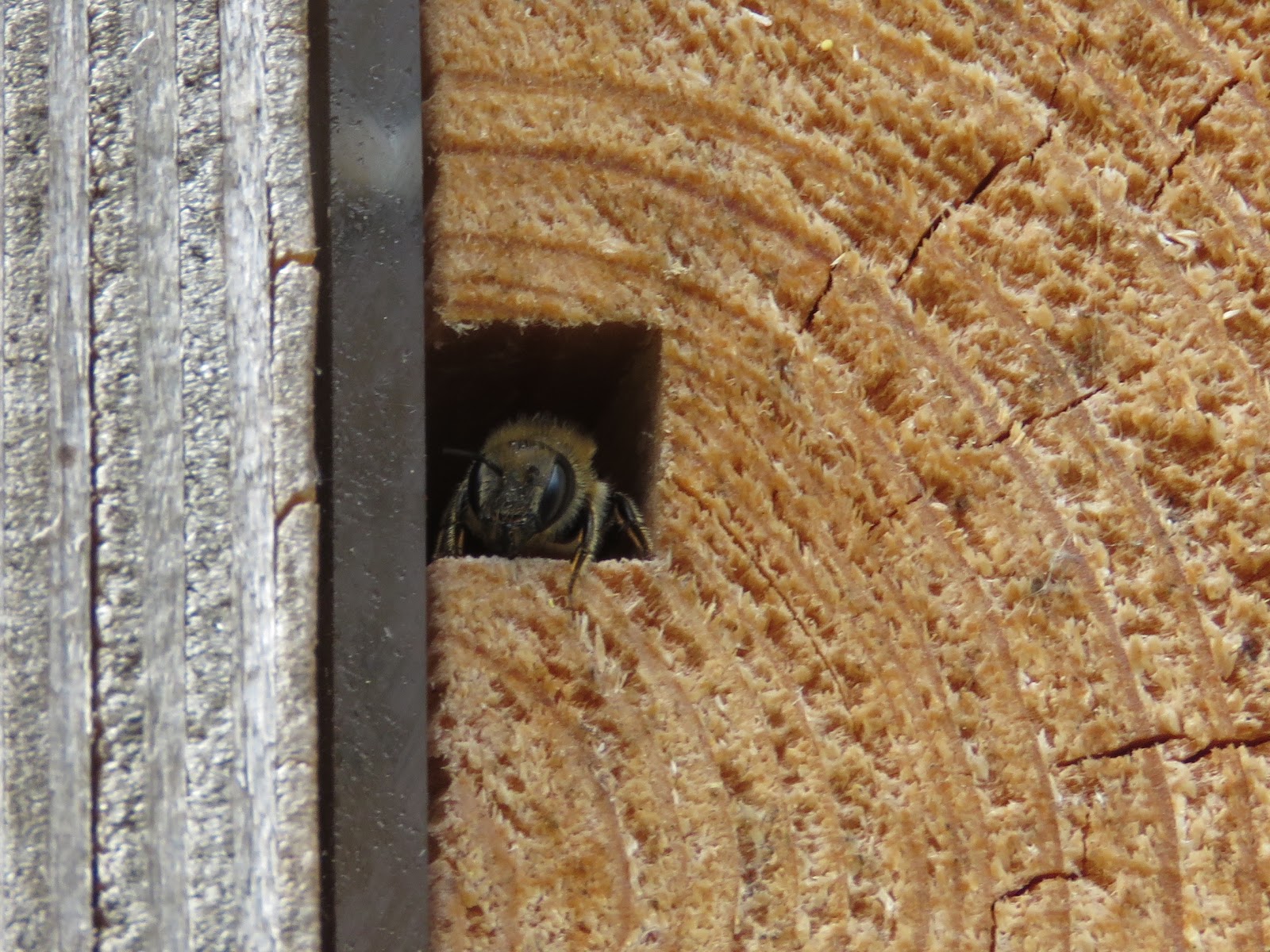
I was puzzled when I checked the bee hotel a couple of days ago. The painstaklingly, lovingly filled nesting cells of the Osmia leaiana nest that illustrated a post a few days ago were gone. There was pollen everwhere and the nest walls made of chewed leaves weren't there. A Megachile willughbiella female, a leafcutter bee, was inside, rubbing its scopa against the walls. Was she the reason for the disappearance of the smaller mason bee's nest or just taking advantage of a previous nest predator?
 Although I'll never know for sure, I think that the leafcutter is probably to blame. There are plenty of empty cavities in the bee hotel, but she apparently decided that this was a better hole than the rest and probably fought the mason bee out of her nest (Leafcutters have formidable scissor-like jaws, and this leafcutter species is a large bee), and then proceeded to empty the contents, eggs, pollen, nectar and walls to make space for her cells. Today, the leafcutter had completed her first cell (above). Note that the walls are still covered in yellow pollen.
 The bee nestbox is providing plenty of surprises and allowing observations very difficult to make in natural holes. The events illustrated here remind me that competition is fierce out there, although in the case of hole nesting bees, it will pass unnoticed in the darkness. Many bumblebee queens are ousted from their nests by other bumblebee queens, not necessarily from cleptoparasitic species, which take over after a fight. In solitary bees and wasps, suitable nest holes might be limiting and intra and intraspeficic competition might be rife, although fights may often take place inside holes. Watch this fascinating video of three bees fighting for a nest hole by George Pilkington, and this series of photos by Simon Saxton documenting two Ectemnius wasps fighting for a nest hole. Nest lining thicker end walls provides physical defence, and might not only protect against cleptoparasitism, but also against other bees taking over, stealing the nest hole and destroying the nest contents.
7th of July. A female Osmia leaiana working on her nest. Note the remains of last year's leafcutters nest in the cavity under it.
16th July, a female leafcutter emptying nest contents by scooping pollen.

Friday, 10 July 2015

A cleptoparasite in the bee hotel


The Red Mason bee is well over in the garden. They have been replaced by their smaller relatives, Osmia leaiana. They have started nesting in the bee hotel and there are several females stocking their nests with nectar and pollen and sealing their nests with chewed up leaves. I removed the side panel of the nest box temporarily to see the progress of the nests. Below is a female with a clump of chewed leaves starting another cell. The yellow lumps are the food supply necessary to nurture one of her larvae to develop into an adult bee.  The bee needs many pollen collecting trips to complete a cell, and then many other trips to collect the leaves to build the cell that will seal each of her nests compartments.
Well, that's the mason bee's plan. However, there are other bees and wasps with their own intentions regarding these laboriously collected clumps of pollen and nectar: they are cleptoparasites. They will take advantage of a female bee outing in search of flowers, enter the nest and lay an egg next to the bees egg. The cleptoparasite egg either hatches earlier, or the parasite larva kill the bee larva to have the food to itself. One of these cleptoparasites is the wasp Sapyga quinquepunctata (above), a black, thin, long wasp with iridescent blue/purple wings and white marks on the abdomen. A female was around the bee hotel today. She inspected each hole, checking it there were bees in them and if they had cells in construction. One of the times, as she left the hole, a mason bee appeared in its entrance. The wasp is careful not to enter a nest containing a bee, presumably because the bees are aggressive to intruders (and have their stings to defend themselves).
This bee hotel with observation panels was designed by George Pilkington, check his website, where he has many informative videos and posts on solitary bees and bumblebees.

Thursday, 19 June 2014

Mouse spider nest

As I checked the bee hotel, the Mouse Spider, Scotophaeus blackwalli, was looking considerably thinner than last time I checked. And lo and behold! She was guarding a fresh, pure white silky cocoon holding her eggs in a neat bundle. I will update this posts with further developments.

UPDATE 9th July. The female is still sitting right on top of the egg sac.

Tuesday, 20 May 2014

A new bee hotel and its guests

This year I got a new bee hotel, kindly given to me by George Pilkington from Nurturing Nature. What a great present! His bee hotel design has removable wooden sides with glass covering the actual grooves in the wood, so that you can remove the wooden sides and inspect the cells as they are being built, a rare peek into this usually hidden world. It is designed to provide suitable nesting holes for the common Red Mason Bee, Osmia rufa, which would naturally would use holes in masonry or cracks on walls to nest.
  I treated the nest with teak oil before hanging it out in early February (above). The Red Mason Bees took to it quite quickly after their appearance in the garden, and on the 11 of April the first female Red Mason Bee Osmia rufa roosted in one of the holes.
Below, a male here inspecting the hotel (14/04/14)
By the 10th of May the topmost hole had been sealed and the second had a couple of cells already made.
a poor photo showing the row of cells containing a mound of pollen, nectar and an egg laid atop. Each cell has a mud wall separating if from the following one (10/05/14).
Once a hole has been filled with cells the bee puts the final wall to cover the nest. This is the first finished row of cells.
On the 12th of May, I spotted the first beautifully fresh and golden Male Osmia caerulescens, sitting on the conservatory window by the sage. The males have been about about a week now, and females a couple of days. Males are very similar to Osmia leaiana males, but O. caerulescens have a strong preference for sage and hedge woundwort in my garden, while leaiana prefers knapweed.
...and the same day this very old, faded and bald male Osmia rufa  guarding the bee hotel.
A cleptoparasite fly Cacoxenus indagator is also present often around the bee hotel. This little fly, related to fruit flies, parasitises Red Mason Bee nests. The fly will lay eggs on the cell as a bee is provisioning it. Its grubs will feed on it, preventing the development and emergence of the bee (17/0514).
This female Osmia rufa is finishing filling the second hole.
On the 17th of May I also noticed a new bee (so I thought!). It turned to be a wasp, Sapyga quinquepunctata, which is a cleptoparasite of solitary bees including from the genus Osmia, the mason bees. I found this wasp on the nest and surrounding area. It has blue-purplish wings and white spotted abdomen, with curved antennae. Thank you to Ian Beavis who identified it from one of my photos on Twitter.
Another view of the wasp, on the post holding the nest. The wasp is also a cleptoparasite of Osmia and related bees.
The bee hotel today. Four cells have been completed.

Not only the bee hotel makes it easier to observe mason bees, but other bees and their cleptoparasites will also be attracted to it, increasing the chances of observing their development in the nest and interactions. Also to note that a spider, possibly Clubiona sp, has made a home in one of the holes.
Undoubtedly, I will post more on future developments on this bee hotel.

Tuesday, 23 July 2013

Bee hotel guests

Bee hotels are very popular at the moment. Most garden centres sell them, and they are advertised as homes for solitary bees. Solitary bees do use these bee hotels to make their nests, but once you get guests, how to tell them apart?
I was inspired to write this post after a twitter exchange starting with this message:
 With this post, I hope to give you an overview of what species of bees are likely to use bee hotels. In fact, only a small number of the over 250 species of solitary bees in the UK are likely to use bee hotels, so, with a bit of patience, identification is likely. For a start, not all solitary bees use bee hotels as they do not nest in cavities. Many solitary bees nest in the soil (the mining bees), others prefer the mortar of walls, or dig their nests in dead wood, or prefer much smaller holes or crevices than those provided in commercial bee hotels, which are usually made out of bamboo or reed canes. Mind, you, many more solitary bee species will be found in your garden than the ones that use the bee hotel. Once a female bee choses a tube in the bee hotel for nesting, you are likely to notice some activity, as she stocks the nest with nectar and pollen, lays eggs and builds partitions between the cells where her offspring will grow. Once she runs out of space in one tube she makes a stout plug and may start to fill another tube with more cells. The males searching for females or patrolling the area of the bee hotel can also bee noticeable.
 In addition to bees, other insects like some digger wasps or the cuckoo bees or flies that parasitise the bees themselves or spiders will also be seen on or near the bee hotel. My experience is on the north of England, and with home made bee hotels made by drilling holes in pieces of wood, so it is likely a few more species will be found to use bee hotels in the south.
 For identification purposes, time of the year, general size of the bee (use a honeybee as a guide) and colour patterns are useful. Also, it is very helpful if you can check what the bees are carrying as nest materials and the colour of the brush of hairs under the bees' abdomen that they use to carry pollen. The material of the plug covering the finished nests can also provide information as to what species built it. Once you can recognise the species or species group of the bees using your hotel, they are bound to provide an endless source of fascination, and bee watching may be addictive, so make sure you place your bee hotel in a spot you can easily and comfortably watch at close quarters!
Red Mason Bees
These are likely to be the first bees in spring using a bee hotel and the most likely species to use bee hotels. The bees are active from March to May. The females are reddish, with large, black heads, and size similar to honeybees. They have characteristic 'horns' on their faces, which they use to mould mud (above). Males are also reddish, smaller and with a white moustache. Males often sit on or near the bee hotel, sunbathing and looking for females.
  Mason bees use mud to partition cells in the bee hotel holes. They will travel from the bee hotel to the edge of ponds where they fetch mud, a little pellet at a time. Click here for more posts on Red Mason Bees in BugBlog.
Blue Mason Bees
These are much smaller bees and there are two similar species, Osmia leaiana and Osmia caerulescens (the blue mason bee proper). Males of both species are metallic green. They like to sit on the nest or stones or leaves at low level to sunbathe and from there they do patrolling flights in search of females. The females are metallic dark blue with a dark pollen brush underneath (O. caerulescens) or dark brown with an orange pollen rush (O. leaiana, above). Both species use chewed leaves to partition their cells.
Leaf-Cutter Bees
These are high summer bees, flying from mid May to August. I have two species in the garden, a large one and a small one. There are other common species in the UK, so care should be taken with identification. The male of the large species, Megachile willughbiella, is easier to identify, as it sports white-golden mittens on its front legs, which are very visible as he sits on the nest or sunny spots and grooms himself. Other identification features are the colour of the pollen brush on the underside of the abdomen: either orange (in the smaller species M. centuncularis, above) or red and black in M. willughiella (below). It is worth checking your bee hotel in poor weather, as these sun-loving bees like to use it as shelter in cold or wet conditions. More on leaf-cutter bees in BugBlog.
 Female Megachile willughbiella. Note the red and black brush of hairs under abdomen
Megachile willughbiella male. Note the pale 'mittens' on his front legs.
A few photos of the looks of the finished nests follows.
Two M. willughbiella males with two Osmia rufa (grey mortar looking) and a O. leaiana/caerulescens at the top, which is made of chewed leaves). 
A completed nest of a leaf cutter bee, Megachile. They use circular sections of leaves to make their nests.
Two recently completed nests of Osmia leaiana/caerulescens (I suspect the former, which in the last few days has been feeding on knapweed). Photo taken today.
The same area of the bee hotel on the 11th of May, just an Osmia rufa nest had been completed then.

Other bees that are known to use bee hotels in the UK are Chelostoma florisommne and Chelostoma campanularum, other Megachile species and Ectemnius digger wasps.
Ectemnius sp. a digger wasp, emerging from its nest.

More on Bee Hotels
Buglife.
Bees Wasps and Ants Recording Society.
Natural History Museum

Sunday, 19 August 2012

Drama under the barbeque

This morning, while watching the hoverflies feeding on the fennel I realised I wasn't the only one interested in them. A female digger wasp Ectemnius, was poised on a cherry leaf, attentively following the action, and at one point the spotted a suitable hoverfly victim and attempted a capture.
 In the afternoon I came across Ectemnius again. Another female inspecting potential nest holes in a bee hotel, going in and out of them.
 I decided to sit and watch the action, faintly hoping the wasp would start digging a nest. I noticed the characteristic carded silk threads of Amaurobius spiders (top shot), and thought that spiders and digger wasps must come across each other with some frequency as female wasps inspect nesting sites. Then the wasp moved to the log pile under the BBQ and walked in and out amongst the logs. She appeared to have walked onto a silk thread and a false widow spider, Steatoda bipunctata, promptly came out of her refuge. A fight ensued, the wasp trying to bite or sting the spider, the spider spreading silk on the wasp and retreating, and repeating the procedure as the wasp became more and more entangled and buzzed intermitently in her futile attempts to get herself free.
 
The commotion got an Amaurobius out of her retreat, and at some point both spiders were attacking the wasp, although the Steatoda managed to secure it and, when the wasp stopped fighting, the spider cut free the threads that attached the prey to the log, and pull her to the safety of the retreat.
Early stages of the fight
The Amaurobius' legs are visible behind the abdomen of the wasp in the shot above, while the Steatoda secures the jaws of the wasp with more threads of silk
The wasp front end is now tightly wrapped on silk, now the spider focuses on the rear end
The spider drags the wasp to her retreat
 I watched all this with amazement and struggled to get decent photos as the action happened almost behind the log. The whole sequence of events happened within 15 minutes!

Friday, 23 March 2012

Solitary bees are back!

In the last week I have been spotting more and more species of solitary bees around. First on scene, as usual, at the beginning of March, Anthophora plumipes, the Hairy Footed Flower bee. Then, a couple of days ago I saw the first Andrena fulva (Tawny mining bee) and yesterday I saw a couple of unidentified Andrena sp. (below). Today the garden was buzzing with at least 4 males A. plumipes, and a female feeding on Erysimum, and the cast was complete when in the afternoon a male Osmia rufa (Red Mining Bee) turned up and stopped to bask on the wooden frame of the conservatory (above). All of them have broken records as to how early they have appeared in the year compared to my previous records, which is not surprising given how mild this winter has been. From a few days to a few weeks before previous years, just as many flowers are also blooming early. The Red Mason Bees breed in our bee hotel, but we have been making another one from reclaimed floorboards and canes, I will push to finish it this weekend as females won't take long to appear.
 Are your bees early too?
Andrena sp.
Another Andrena enjoying a Dandelion
The new bee hotel in construction

Friday, 1 July 2011

Leaf-cutter bee antics

There has been a lot of leaf-cutter bee activity in the last week in the garden. Females collect nectar and pollen from Campanula, wild rocket (female collecting pollen above), everlasting peas, and birds foot trefoil. They have colourful pollen baskets underneath their abdomen.
 Males patrol the females' favourite nectar and pollen sources. Here a male Megachile willughbiella, easily recognisable by their white-golden mittens and moustache, flies by everlasting pea flowers.
They also keep a close eye on the bee hotel, where, for the first time, I have seen nesting activity, and often bask on top of it or nearby on sunny spells.
Males of Megachile willughbiella also "sleep" in the hotel, or seek refuge during cold or rainy spells. On the photo above, two males settle for the night. The plugged nests around them belong to Osmia rufa, the red mason bee.
When they detect a female feeding, males hover in front of them for a little while before attempting mating. The following description is for Megachile fortis, an American species of leaf-cutter by John Neff and Beryl Simpson, may well apply to the british Megachile species:
 When a female was encountered on a sunflower head, the male hovered in front of the capitulum while the female moved around it, probing the circular array of florets. When the female reached the 1200 position (aligned vertically on the capitulum with her head up) he darted forward and grasped her with his fore and mid legs, rapidly curling his abdomen under the tip of her abdomen, apparently attempting copulation. Both bees then dropped from the flower with the female quickly escaping or being released to fly away and resume foraging. The period from pouncing on the female to release was quite brief, typically less than 3 seconds.
 Today I had the chance to observe a female Megachile willughbiella repelling a male. She was basking on top of the bee hotel and the patrolling male spotted her. He pounced on her but she curled her abdomen up as you can see in the photo above. The male flew away and the female adopted a more relaxed position. Leaf-cutter have very mobile abdomens and tend to tip them upwards. I have no idea why, but I wonder if it has something to do with their pollen collecting. However, males also have this tendency to raise their abdomens when feeding or just when preening themselves.
 I have posted before on these species leaf-cutting behaviour itself, but I had never had the chance to look at a finished nest from close up. Two nests were finished in the last couple of days in the bee hotel. As you can see below, nests come in colours. I wonder if the yellow one is made out of Potentilla petal sections.

Both species of leaf-cutters are nesting in the bee hotel, the smaller I believe is M. centuncularis and the large, M. willughbiella.
Here a female M. centuncularis, recognisable by her all orange pollen brush and marked white striped abdomen, works on the yellow nest.
Reference
John L. Neff and Beryl B. Simpson. 1991. Nest Biology and Mating Behavior of Megachile fortis in Central Texas (Hymenoptera:Megachilidae) Journal of the Kansas Entomological Society, 64: 324-336.