Showing posts with label Dysdera. Show all posts

Tuesday, 3 November 2015

Spiders in glasshouses

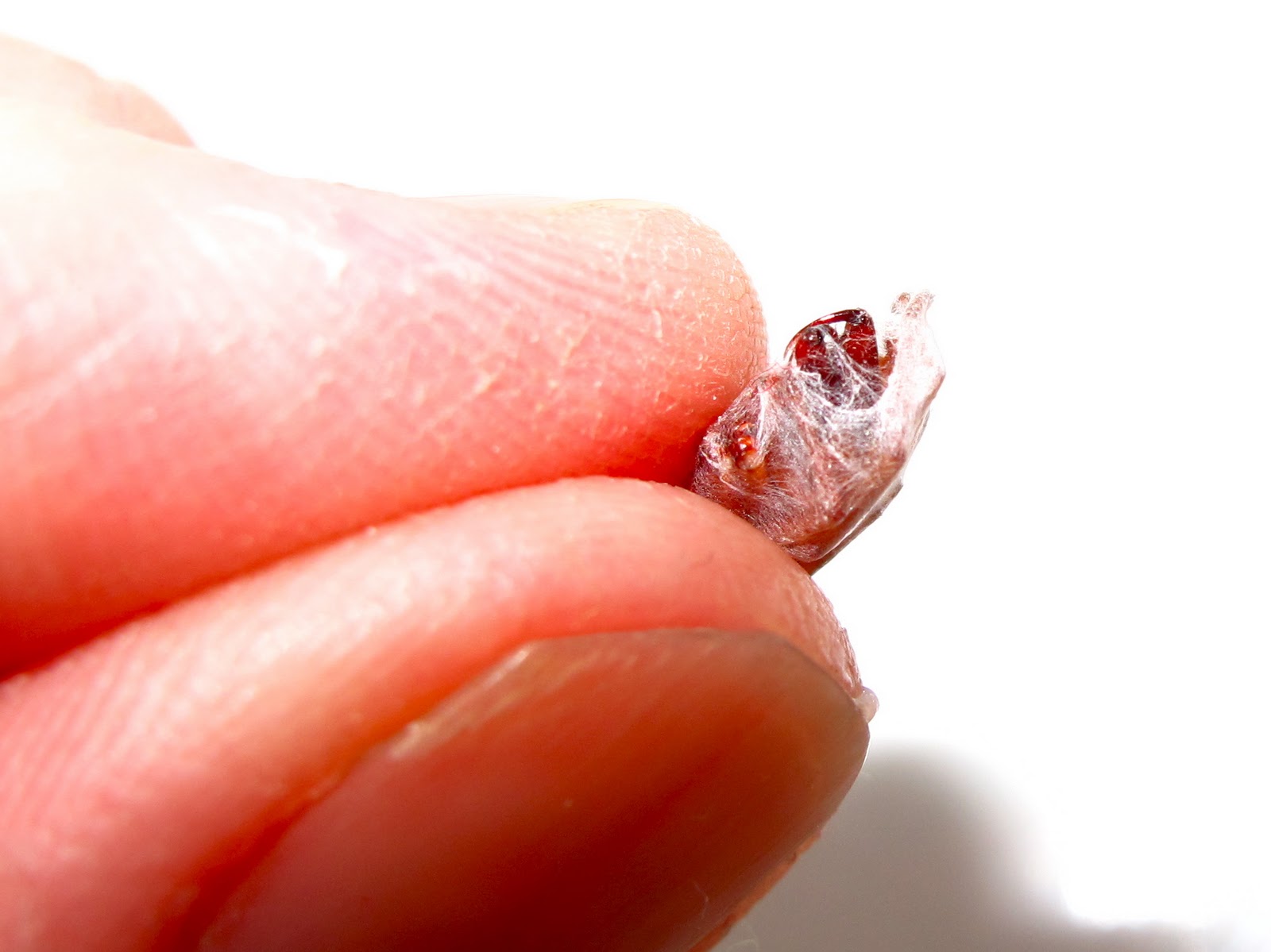
Today at work, I had the chance of inspecting some glasshouses in the Thwaite Botanical Gardens of the University of Hull. They are heated glasshouses holding cacti, succulents, ferns and other plants from around the world. I was pleasingly surprised by the diversity of spiders in them. I found a single Woodlouse Spider, Dysdera crocata, under a bin (above). Quite fitting as we were collecting woodlouse for a practical on woodlouse diversity. The students were quite impressed!
 The first surprise was to find several Walnut Orb Weavers, Nuctenea umbratica. We dislodged an individual from a tree growing in a pot and it proceeded to play dead, legs drawn in, as they do when disturbed. They are usually nocturnal, spending the day in a crack in bark, but this large female I found later was sitting in the middle of her web, I wonder if the reason is it was a very dark, overcast day. There were many more smaller sized individuals, also sitting out in their webs, and it is quite likely this spider matures on her second year of age.
Mature female Nuctenea umbratica.
A student pointed this female Tegenaria to me, she found under a tarpaulin.
A mature, gravid Araneus diadematus sitting on her web.
This was the second nice surprise. One of the glasshouses held a healthy population of Garden Centre spiders, Uloborus plumipes.
By the toilets, a number of Pholcus phalangioides.
Where there are windows, there are window-frame spiders, Zygiella x-notata. 
I found a single Ero sp. egg sac. These spiders abandon their characteristic egg sacs, and they are not the easiest to find.
On a window ledged, a female Araneus diadematus looking like it has seen better days. Its abdomen shrivelled. Her days are counted after she lays her eggs and weaves her egg sac.

Friday, 2 October 2015

Dysderidae: Woodlouse hunters


My second spider family, Dysderidae, is a much smaller family in the UK, with only four species of wandering, nocturnal hunters. They are unusual in having just six, not eight eyes, arranged close together. They don't build a hunting web, but use their silk to spin cells under stones or logs where they hide during the day. Females wrap their eggs in silk and guard the egg sac. The most widespread is Dysdera crocata, a species that is actually cosmopolitan as a result introductions in North America and elsewhere, and that is often associated to human habitations.

Fangs!
It is a brightly colourful spider, with a flattened, elongated appearance. However, their most striking feature are their massive chelicerae projecting forward. These, together with their long fangs enables them to be able to hold the woodlice like pincers, and inject venom in the softer underside of the animal. Woodlice likely comprise the bulk of their diet.
I disturbed this D. crocata as it was feeding on a woodlouse under a pot.
 A mature female roaming in the open at night

A male and a female individuals in threatening position: fangs wide open, bodies and front legs lifted and keeping their distance from one another.


Saturday, 26 March 2011

Spider breakfast bowl encounter

This morning I was getting ready to mop the kitchen when a I noticed a recently dead spider under the mop, a female Dysdera crocata. I thought I had just squished it inadvertently, left it aside for later photos, and filled the bucket. A I lifted the mop again, two spiders fell out of it, an Amaurobius and a female Dysdera. I got a couple of drinking glasses and put them over the spiders and started mopping. Up to then I was only a bit surprised by the attractiveness of this old mop for spiders but little else. I moved to the next room while mopping the floor and... yes, you guessed it! another spider fell out of the mop (number 4!) this time a male D. crocata, looking positively angry, lifting his front legs and fangs open! I grabbed another glass and card to fetch him and proceeded to shake the mop thoroughly. Number 5, a small, this one dead, but in good condition otherwise D. crocata fell out. I couldn't carry on with the mopping. I had three live spiders under glass including two adult male and female Dysderas. I had to stage an encounter between them, a breakfast bowl encounter. It was tricky, as they were warm and easily climbed out of the bowl several times, but I finally managed to put both spiders on the bowl under a glass and they settled. The male was only slightly smaller than the female. I slightly touched the male with the glass and he made contact with the female. As a lighting strike, they lifted their front legs and opened their chelicerae to the maximum and faced each other. I lifted the glass carefully and watched. The spiders stood their ground and wrestled with their fangs opened. After a few moments, the female retreated and the male run away. What were so many spiders doing in the mop? Is this a particularly good hiding place in the outside toilet? is it the mating season? or they are part of the same brood that have become trapped in the toilet. I doubt the later as the spiders are good climbing even glass and the window is always slightly open. The spiders did not seem very keen to mate. I wonder, as there are many woodlice in the outside toilet and it might be that these spiders are not territorial and are just exploiting it as the perfect hunting grounds. This post is a very strange end for a kitchen mopping session!
The spiders before I removed the glass

Sizing up their fangs

Friday, 25 March 2011

Pholcus 1, Dysdera 0

I mentioned the other day that the Pholcus in my outside toilet was holding a wrapped spider and was looking considerably fatter (above). The following day, I picked from the floor the remains of her prey, which she had dropped. I was shocked to find it was a fearsome Dysdera, the woodlice hunting spider. I tried to unwrap it to get a better shot, but it was difficult. Fortunately, the fangs stuck out. I don't think there is any other British spider with such long fangs and chelicers of red colour. These flimsy spiders make good bets for spider battles!
click to embiggen

Saturday, 12 March 2011

Dysdera crocata showing its impressive fangs

I was moving some pots outside when I found a female Dysdera, the Woodlice hunting spider: an excellent subject for my breakfast bowl technique. I carefully put the spider in a little plastic bug pot, grab the bowl and camera and go outside. Despite the sun, with no flash the spider colours do not come out very well so I use a flash. I want a shot of the fangs so I gently tickle them with a piece of grass and voila! the spider delivers. I can check later that it has got spines on the upper side of the femur in the back legs (see photo below), which is the character that identifies it as a D. crocata, and separates it from Dysdera erythrina, the other British species. D. crocata is also more often found in gardens, and reaches a more northern distribution than D. erythrina.

Monday, 19 April 2010

Night prowl

I had to go out late at night in the garden a few days ago. I took the torch as I dislike squishing slugs or snails walking on the path. Indeed, there were a few yellow slugs (Limax flavus), garden slugs (Arion hortensis) and Common rough woodlice, but, surprisingly, prowling in the middle of the path, I found a shockingly bright-coloured female woodlouse hunting spider (Dysdera crocata) - of which I wrote a post recently.
The spider seemed uninterested in woodlice, by the way, as it walked around one of them. A pleasure to observe this nocturnal spider in its environment.

Tuesday, 30 March 2010

Woodlice hunting spiders

I occasionally come across Woodlice hunting spiders (Dysdera) in their silky day retreats when moving pots. These relatively large and brightly coloured spiders are strongly photophobic and run away from the light as fast as they can looking like they are dragging their bodies on the ground as they go. I haven't managed to take a decent photo of these spiders outside my plastic bug container (above) because of they dislike of lights. Dysdera spiders have traditionally been considered specialists on hunting woodlice. They have long, thin and highly mobile forward facing chelicerae (fangs) which it uses as pincers, catching the woodlice and then piercing the underside not as armoured side of woodlice. They are known to be able to deliver a painful bite if handled by brave humans. As they hunt during the night, when they come out of their retreats, their diet is difficult to study in the wild and there is some debate as to how specialised on woodlice these spiders are. In captivity, they are not fussy eaters, and feed on a variety of invertebrates, they seem to say no to nothing! What is certain is that they do eat woodlice, and the few times that they have been found in the wild with a captured woodlice suggests they might be an important part of their diet. Dysdera spiderlings raised on woodlice alone or combined with flies grew faster than those raised only on flies, sugesting some degree of physiological specialisation. In addition, not many spiders like woodlice - one of the few is the daddy long legs spider Pholcus- and here is a photo of it.
A Pholcus with its woodlouse prey in the kitchen

More information
S.D. Pollard, R.R. Jackson, A. van Olphen and M.W. Robertson (1995) Does Dysdera crocata (Araneae: Dysderidae) prefer woodlice as prey? Ethology, Ecolgy & Evolution 7:121-275. here.

J. A. L. Cooke (1965) A Contribution to the Biology of the British Spiders belonging to the Genus Dysdera. Oikos, Vol. 16:20-25. here.


Milan Rezac and Stano Pekar (2007) Evidence for woodlice-specialization in Dysdera spiders: behavioural versus developmental approaches. Physiological Entomology 32: 367-371. here.