A
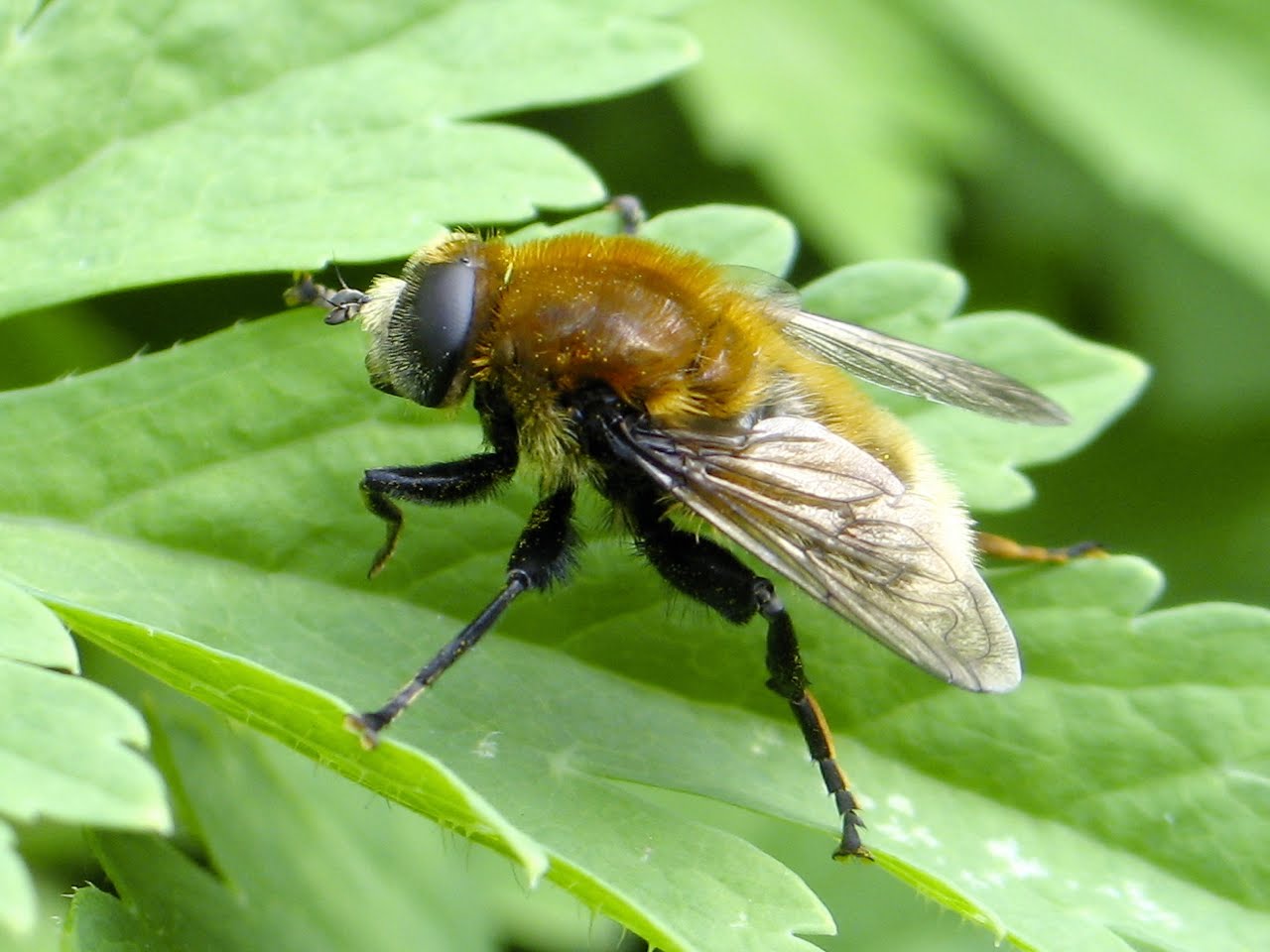
Bombus lapidarius flies by, and stops to sunbathe on a leaf...but, wait a minute!, bumblebees industriousness clashes a bit with this behaviour, and I have a second look. Doh! it's not a bumblebee, but a mimic: the large, colourful and furry hoverfly
Merodon equestris. It is easy to be fooled. This individual is all black, with a bright red tail. The costume is so good, you can't stop watching: even the back femur is thicker like its mimicking the bee's pollen baskets! And it gets more fascinating still:
Merodon equestris is highly polymorphic and different individuals colour patterns mimic different bumblebee species. Earlier in the month I came across one looking like
Bombus pratorum and another like
Bombus pascuorum. The different forms are actually just colour morphs that interbreed with one another, as shown in one of the photos below. Some of the colour patterns are sex-specific, that is, they are always male or female (the 'lapidarius' looking form is always a female). This fly can be found from April to September, but it is most abundant in May-June. The species is native from southern Europe and is thought to have been introduced in the UK from the continent - where it was first recorded in 1869 - in shipments of flower bulbs, on which the larvae feed, hence its common name, Large Narcissus Bulb Fly
Imitating Bombus pratorum
This male looks a bit like B. pascuorum
Two colour forms mating on the side of a pot.