Showing posts with label Crab Spider. Show all posts

Wednesday, 11 April 2012

The sunny side of the fence

The outside of our garden fence is east facing. Many insects and spiders like to bask on it: even normally ground loving invertebrates climb up on it to get the sun a bit earlier. In the last few days I have been watching (mainly) spiders on the fence early in the morning. The male Nursery Web spider (Pisaura mirabilis) on the top shot, warms up on the side of the fence, in almost the same spot every day.
After warming up yesterday he went down to the weeds at the base of the fence to hunt, and caught a greenbottle fly
A crane fly resting, legs outstretched on the fence.
A male Xysticus cristatus, much darker in tone than the female. This is a ground dwelling crab spider and he was basking about 10 cm from the ground, but it is much easier to spot on the fence.
And an eager male Wolf Spider displaying to the female. Alternatively lifting each palp, trembling and getting closer to her very slowly on tiptoes. She kept tapping the ground with their front legs, and didn't miss a movement. When he got very close, almost touching her, she retreated cautiously, tapping regularly.

Saturday, 9 April 2011

A spider in ant disguise

ResearchBlogging.orgMy young daughter does not like ants. This is a bit troublesome at this time of the year when garden ants are everyhwere. Yesterday, she pointed at something on the ground. I looked at I saw what looked like an ant carrying another ant running very fast. It must have looked a bit odd as I stopped the "ant" putting my hand in front of it. She hid underneath and I slowly lifted my hand and took a couple of shots. Only when revising the shots did I realised that the ant was only an illusion: it was a spider, but one that strongly resembles an ant not only in size, general shape, shininess, but also in posture and behaviour. She carried her front legs raised so that it looks like its got antennae and six legs, and its movements were most reminiscent of the manic running of ants in hot weather.
In her review of ant mimicry in spiders Paula Cushing stated referring to morphological spider modifications to resemble ants:

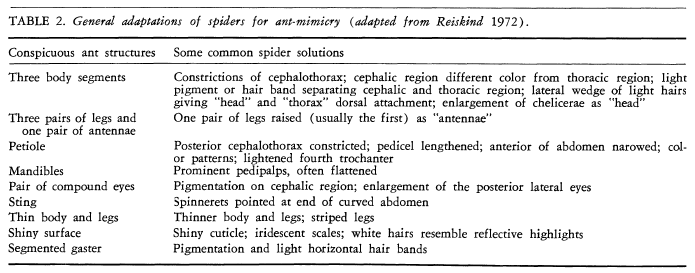
They include a variety of color and body-form modifications that give the spider the appearance of having three body segments instead of two and of having long, narrow legs instead of shorter, more robust legs. Mandibles, compound eyes and even stings are sometimes mimicked by the spiders through modifications in the chelicerae, pigmentation in the cuticle, or special positioning of the spinnerets. In many cases, the extent to which the mimics resemble a particular model is extraordinary
The following table helps in dispelling the notion that this ant resemblance is just a fantasy of the observer.
There are many species of invertebrates that have evolved to resemble ants including crickets, bugs, beetles, springtails, and even flies. At least 100 species of spiders of 12 families mimic ants. The formal name for this phenomenon is ant mimicry or myrmecomorphy. But why would a spider evolve to look like an ant? A few spiders resembles ants in order to get close to them and eat them (aggressive mimicry), but most ant mimic spiders benefit because visual predators take them for ants, and avoid eating them. This is a case of protective or Batesian mimicry, the mimic imitating a dangerous model. Ants can be distasteful or aggressive or both, with biting jaws, a spray of formic acid and a sting. Given that the deception is visual the selective agent must be highly visual: birds, wasps, hunter spiders that normally avoid ants would avoid an ant mimic in the same way, therefore a small spider may have much to gain from resembling a common local ant. My little ant-spider is most likely Micaria pulicaria, a widespread species in the U.K. often found running in the company of common garden ants. It is not reported that it preys on ants so, the reason for its ant mimicry, most likely involves Batesian mimicry. Interestingly, it is the only diurnal genus in a mostly nocturnal hunter spider family - Gnaphosidae, for an example see this post - and ant mimicry might have help this spider lineage conquer and diversify in a diurnal niche.

References
Cushing, P. (1997). Myrmecomorphy and Myrmecophily in Spiders: A Review. The Florida Entomologist, 80 (2) DOI: 10.2307/3495552
Reiskind, J. (1977). Ant-Mimicry in Panamanian Clubionid and Salticid Spiders. (Araneae: Clubionidae, Salticidae) Biotropica, 9 (1) DOI: 10.2307/2387854

Monday, 4 April 2011

Ground Crab Spider

ResearchBlogging.orgUntil a couple of weeks ago, I was under the mistaken impression that there were no crab spiders in the north of the U.K. Although this is true for flower crab spider, Misumena vatia, a chamaleon-like hunter that changes colour to match the flower is sitting on, there are many other species that are widely distributed, in the U.K. as I found out through a thread in Wild About Britain. All crab spiders have some ability to change colour to match their surroundings and become invisible to their unsuspecting prey. They do not build a web to hunt, instead, they rely on their superb camouflage and their front two pairs of legs, larger than the rest and furnished with forward facing spines, which they keep open when hunting, forming like a living trap. Their's is a stalking strategy, sitting with its outstretched legs waiting for invertebrates to turn up. The name crab spiders suits them well, as their oversized front legs, divergent lateral eyes and sideway walking makes them look like miniature crabs. One of the most widespread crab spider is Xysticus cristatus. This crab spider is found on the ground or on low vegetation, although it can also hunt in flowers. The female above was sunbathing on my conservatory frame on an awkward corner for photos. I captured it and took a few shots in the while bowl. I released it on a dandelion (above) - before I found out about its preferred hunting grounds - but she didn't like it and scuttled away relatively quickly.
Xysticus cristatus female on her crab-like stance
Unlike flower crab spiders, which feed mainly on pollinators - bees, hoverflies and butterflies - ground crab spiders feed on a wide range of prey, from small prey such as ants aphids and springtails to the larger bees and butterflies, and other spider species, even earthworms! (see Figure below from Nyffeler & Breene). Birkhoffer and coleagues found that Xysticus cristatus - together with wolf spiders - eat larger proportions of aphids when compared to web building spiders. Their common aphid prey might make them a suitable biological control, retarding the population growth of aphids during spring so the authors suggested to encourage habitats favourable to these spiders near crops.
References
Nyffeler, M., & Breene, R. (1990). Spiders associated with selected European hay meadows, and the effects of habitat disturbance, with the predation ecology of the crab spiders, Xysticus spp. (Araneae, Thomisidae) Journal of Applied Entomology, 110 (1-5), 149-159 DOI: 10.1111/j.1439-0418.1990.tb00108.x
Birkhofer K, Gavish-Regev E, Endlweber K, Lubin YD, von Berg K, Wise DH, & Scheu S (2008). Cursorial spiders retard initial aphid population growth at low densities in winter wheat. Bulletin of entomological research, 98 (3), 249-55 PMID: 18439342