Showing posts with label colonisation. Show all posts

Tuesday, 10 September 2019

Willow Emerald twitch at East Park

When I posted the Hull Dragons August summary on the 6th of September, I noted that, regarding the Willow Emerald Damselfly "there is a possibility this rapidly expanding species may make it into Hull in the near future". But I was never expecting the near future to be as quick as 48 hours! @pondwatcher on Twitter:

How exciting was that!?
The Willow Emerald benefits from urbanisation, as it favours permanent garden and park ponds, surrounded by trees or bushes. Its is a late flying species, making the end of the dragonfly/damselfly season more exciting. It is the only Odonata species that oviposits into live wood, usually thin branches overhanging water, where eggs induce a diagnostic, gall-like reaction in the wood in a pattern of parallel lines.
 After a few sporadic records, the Willow Emerald became a regular breeding species in the UK in 2009, where many breeding colonies were discovered in Suffolk. Since then, it has steadily increased in range west and north, and this year it crossed the Humber for the first time.
 Today, there was a forecast of sunny spells and light WNW wind, and I decided to got on a damselfly twitch. I arrived at the park at 9:00 and walked to the eastern side of the lake, where the area around the boardwalk is favoured by dragonflies and damselflies. The first sunny spell took about an hour to arrive. When it did, Migrant Hawker males became active, with up to 5 males sharing the area, patrolling and resting over the large patch of marginal vegetation (above), a single female making a short appearance.
A female Common Darter (above) sat on the railings of the boardwalk, the first record of this species in the park this year. After walking up and down for a while searching for the Willow Emerald and with another large cloud looming, I moved onto the western side of the park to search for Small Red-eyed Damselflies. No luck, not a single damselfly on the west side of the main lake or boating lake.
 After a hot drink in the cafe I returned to the boardwalk. More searching of trees and marginal vegetation and walking up and down the boardwalk. The Migrant Hawkers were active so I watched them for a while. It was 12:20, the temperature quite pleasant in the sun, barely a breeze. Two male Common Darters were in attendance, chasing. After three hours in the park, I thought I had to content myself with a tandem pair of Common Darters, which were looking for an oviposition site. Maybe the Willow Emerald had succumbed to predation, of moved on. Another cloud was coming. I thought I'd stay for the next sunny spell. Then, a lovely, large sturdy green damselfly flitted about, checked the passing pair of hesitant darters in tandem, and sat on a leaf near the boardwalk: yes! the male Willow Emerald! It gave the impression of a sizeable insect, it is indeed as long or a bit longer than a common darter, and a stronger flyer than the common emerald. It sat on exposed leaves over the water, moving every now and then to another perch. It sat on alder leaves, on branched burr reed flower heads and leaves. I could take plenty of photos, as I watched it for about 20 min. A lovely damselfly tick!
This photo shows the 'spur' on the side of the thorax and the pale pterostigma with dark edges.
The pale appendages are also distinctive. No bluish pruinescence is apparent.

Willow Emerald males often sit on low branches of trees, overhanging water, which are the ovipositing sites chosen by females.

Monday, 30 July 2018

Small Red-eyed Damselfly range expansion

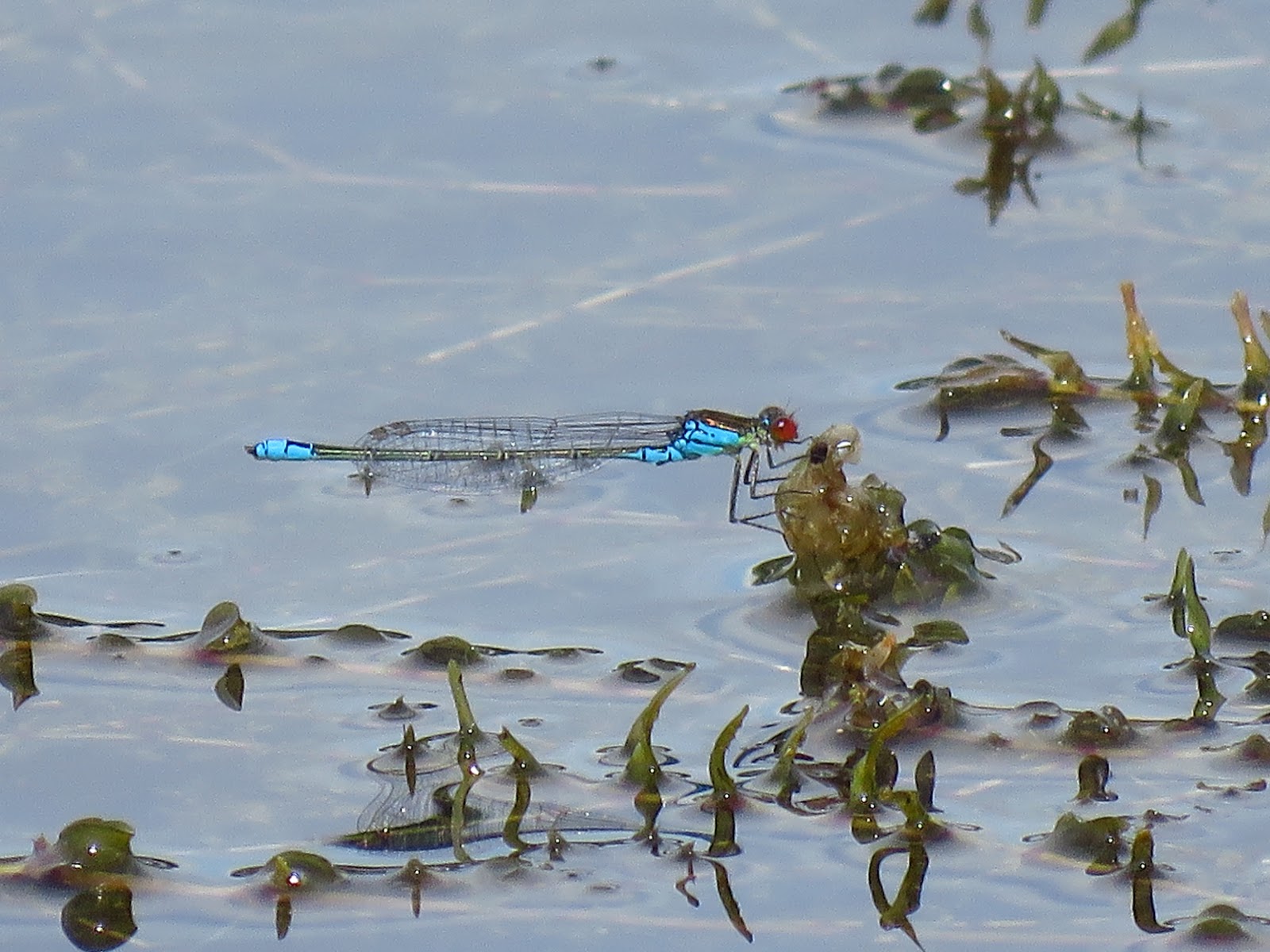
This morning I watched several males of the Small Red-eyed damselfly at North Cave Wetlands, a YWT nature reserve with a diversity of large lakes, shallow reed bed lakes and dragonfly ponds (top shot). It was the first time I see this species in this site, where is now established. The Small Red-eyed is quite a distinctive damselfly, but it can be confused with its relative the Red-eyed Damselfly. The Small Red-eyed has an later flight season (end of July-August, although they do overlap), is smaller, has more blue in the tip of the abdomen and tends to sit with the abdomen curved upwards. Both species like to sit away from the shore, on floating aquatic plants, and individuals come back to the same spot after hunting. Given their habits and small size binoculars are a must to identify it!
Female Small Red-eyed Damselfly at Clubley's Scrapes (Spurn NNR, 21/07/18)
 The Small Red-eyed has been a British species for less than two decades. After a range expansion within Europe culminating with the colonisation of the Netherlands and Belgium, the species was first recorded in coastal sites in the south of the UK in 1999 and rapidly expanded north and west at a pace of 28 km per year. Today it is present up to North Yorkshire, but the rate of expansion is reducing. In 2006 it was first found in East Yorkshire, in a fishing lake in Hull, Oak Road Lake, and now it is present in several East Yorkshire sites.
 Colonisation can be associated with loss of genetic diversity, especially if the species in question is a poor disperser or population growth is slow after establishment. Given the speed and recency of colonisation of the Small Red-eyed Phillips Watts and colleagues investigated the genetic relationship and genetic diversity of nearby European populations and UK ones. It was presumed that the waves of migration came from NW France and Belgium, but there was another colonisation centre in the UK around the Isle of Wight, which hadn't expanded as much. Watts screened Small Red-eyed populations with 10 very variable molecular markers, similar to the markers used in forensics. The Isle of Wight population had less diversity than the remaining British populations, but the populations involved in the main expansion had a similar diversity to European populations investigated, with no evidence of population bottlenecks. This indicated that the waves of colonisation from the continent likely involved large numbers of individuals, and or colonising populations grew rapidly after establishment precluding losses of genetic diversity. Although it might appears surprising that this tiny insect can be capable of long distance dispersal and rapid colonisation, but migration is a increasingly acknowledged feature of many insects.
Small Red-eyed in flight.
Spot the tiny Small Red-eyed underneath an ovipositing pair of Common Darters and a Common Blue Damselfly.

More information
Watts, P. C., Keat, S. & Thompson, D. J. Patterns of spatial genetic structure and diversity at the onset of a rapid range expansion: colonisation of the UK by the small red-eyed damselfly Erythromma viridulum. Biol. Invasions 12, 3887–3903 (2010).

Thursday, 31 May 2018

Chasing the climate: Broad-bodied chaser and the dragonflies of East Yorkshire

There are 45 dragonfly and damselfly species in the UK, of which 23 breed in East Yorkshire. I was amazed to find that 15 of these have established themselves in the county only after WWII. The recent colonists include now common and widespread species like the Common Darter, the Blue-tailed Damselfly and the Emperor Dragonfly.
Cumulative number of East Yorkshire dragonfly and damselfly species and the first record of each colonist species (data compiled from Paul Ashton's Dragonflies of South East Yorkshire, 2013).

 Recent studies taking advantage of the wealth of records held by the British Dragonfly Society indicate that warming climate largely explains northward range shifts, range expansions and earlier emergence observed in most British dragonflies and damselflies. In contrast, the few northerly species have also shifted their range north, and their ranges remained stable or slightly contracted in size. Some extreme examples of range expansions are the Common Darter, with a northern distribution range that moved north 346 km in 40 years, the Keeled Skimmer shifted 190 km.

  One of the recent East Yorkshire colonists is the Broad-bodied Chaser, with a first record in 1995. It is now quite widespread but still establishing and expanding its range.
Today I visited a pond in a site in the outskirts of the city, which has maintained water until now this year probably due to the higher than usual rainfall this winter and spring. I took advantage of a short sunny spell this afternoon in an altogether warm muggy day to try and see the Broad-bodied Chaser I had seen there before in mid May. This is a large, striking dragonfly, which readily colonises new ponds, including garden ponds. They have a flattened abdomen and dark spots on the base of the wings. Males have a powdery blue abdomen and yellow spots on the sides (top shot), the females a yellow/brown abdomen (below). Males maintain territories in ponds, where females may only approach the pond to mate and oviposit. As an adaptation to the shallow, small ponds where they develop, their larvae are able to move over damp, but otherwise dry terrain if the pools where they are developing are dry.
A female Broad-bodied Chaser (22nd May 2017, Leven Canal)

  Not long after I arrived, a male passed flying by hunting and patrolling over the pond, about half a meter above the water. I briefly saw a female too, which didn't settle. This species flies in a zigzagging way which makes it hard to follow, but it is a large animal, and has a habit of perching in favourite spots regularly, which more than compensates for it. The male settled on the most inaccessible part of the pond a few times, but finally it alighted on a large clump of Yellow Flag irises near me, where I could watch and photograph it easily.

More information
Ashton, P. (2013) Dragonflies of South-east Yorkshire. 105 pp.

Hassall, C., Thompson, D. J., French, G. C. & Harvey, I. F. Historical changes in the phenology of British Odonata are related to climate. Glob. Chang. Biol. 13, 933–941 (2007).

Hickling, R., Roy, D. B., Hill, J. K. & Thomas, C. D. A northward shift of range margins in British Odonata. Glob. Chang. Biol. 11, 502–506 (2005).

Piersanti, S., Rebora, M., Salerno, G. & Gaino, E. Behaviour of the larval dragonfly Libellula depressa (Odonata Libellulidae) in drying pools. Ethol. Ecol. Evol. 19, 127–136 (2007).

Saturday, 16 June 2012

Girl power: sex and parthenogenesis in Vine Weevils

ResearchBlogging.orgPrecariously perched on a young oak branch, a Black Vine weevil, Otiorhynchus sulcatus, the first of the year. I am really not looking forward to seeing them, but they have an intriguing life cycle, which is key to their success. The Black Vine weevil is a generalist feeder which in the early 19th century was only known in a small area in Central Europe and since then has expanded to much of the world aided by human activities and has become a pest of a range of agricultural and horticultural plants, despite being a flightless, sluggish insect.
 The remarkable thing about them is that all Black Vine Weevils are female. A weevil does not need to find a partner to mate before reproducing, she just emerges from the soil, stumbles to the next suitable patch and lay eggs. The next generation of daughters will be genetically identical to their mum, forming natural clones. Parthenogenetic lineages in general are good colonisers, and expand their population ranges more easily than their sexual relatives. Individuals might disperse the same distance during their lives, but in the parthenogenetic species a single individual can successfully colonise a new patch and establish a new population, while the sexual species needs at least two individuals of different sex - or a fertilised female - and then has to cope with the disadvantages of inbreeding if it succeeds. Most parthenogenetic insect species are flightless, which suggests that parthenogenesis is more advantageous if the insect is naturally a poor disperser.
But there is another card up the weevil sleeve. These beetles are triploids, instead of having the usual two sets of chromosomes (that is, being diploids, like us) they have three. Polyploids are often larger than diploids and may enjoy further ecological benefits such as more resistance to the cold or wider ecological tolerances. Ecologically, parthenogenetic weevils have moved much from their origins in the moist valleys of the Alps, and are now able to persist even indoors, munching the roots of plant pots.
They might not be the most attractive insects, but these weevil story of success shows that appearances can be deceiving and that, sometimes, girls rule.

More information

Lundmark M (2010). Otiorhynchus sulcatus, an autopolyploid general-purpose genotype species? Hereditas, 147 (6), 278-82 PMID: 21166797

Tuesday, 23 August 2011

Bath spider hybridization

ResearchBlogging.orgSince the end of July, large spiders with long legs have been running across carpets in the house, or falling in the bath. Being agile spiders that often react to disturbance by jumping and running very fast - as opposed to crouching or playing dead - these are spiders that tend to scare people. They are males of several species of the genus Tegenaria. This guy fell in my bath a couple of nights ago and it has been the most compliant Tegenaria I've had so far. He sat still on the white bowl while I got close to its palps, but despite getting good views, I still was unable to ID it.
The two most common species in the UK are Tegenaria gigantea (=duellica) and T. saeva, and this male's palps could have been either. These closely related species differ in details of the female genitalia and of the morphology of the male palps, but their recent history is blurring the distinction between them in the north of England. Work by Peter Croucher, Geoff Oxford and colleagues from the University of York show that both spider species expanded north after the glaciations from refugia in the Iberian Peninsula. Through the vagaries of the colonisation process until recently, they had a mainly segregated distribution in the UK, with T. gigantea in the east of the country and T. saeva in the west.

Distribution in England and Wales of Tegenaria saeva and T. gigantea based on 10x10 km grid squares of standard maps (Ordnance Survey, the national mapping agency of Great Britain). Black squares, T. saeva; white squares, T. gigantea; grey squares, those containing both species. Spiders with intermediate morphologies are not included (figure from Croucher et al 2007).

In the south of the country, both species distributions meet in a narrow stable zone, in Dorset, where hybridisation appears not to be very common and when it happens results in high hybrid mortality. Since the 1970s, however, both species have expanded into Yorkshire and in this region they often occur in the same places and hybridise commonly, so that their species boundaries are falling apart and many morphologically intermediate forms are found. As Hull is in an area of high hybridisation, my inability to ID the spider might have more to do with my limitations, but there is a high chance there is no "pure" T. gigantea and T. saeva in this area any more, and that these house spiders are actually merging into one as they carry on colonising towards the north.

More information
Croucher, P., Oxford, G., & Searle, J. (2004). Mitochondrial differentiation, introgression and phylogeny of species in the Tegenaria atrica group (Araneae: Agelenidae) Biological Journal of the Linnean Society, 81 (1), 79-89 DOI: 10.1111/j.1095-8312.2004.00280.x
Croucher, P., Jones, R., Searle, J., & Oxford, G. (2007). CONTRASTING PATTERNS OF HYBRIDIZATION IN LARGE HOUSE SPIDERS (TEGENARIA ATRICA GROUP, AGELENIDAE) Evolution, 61 (7), 1622-1640 DOI: 10.1111/j.1558-5646.2007.00146.x

Tuesday, 23 March 2010

Bombus hypnorum here to stay

Coming out of work I see the first Bombus hypnorum of the year: a dying, squished female, possibly a queen. B. hypnorum, or the tree bumblebee is a newcomer in the UK. It appears to have arrived on its own steam, possibly an inseminated queen crossed the channel around the turn of the century. The first specimen was collected in the New Forest in July 2001. In mainland Europe it is a species closely associated to human habitats. It is a species quite easy to identify due to its striking coloration: ginger thorax and black abdomen with a white tail. It is a good size bumblebee, similar to B. terrestris.
 In July 2005 I reported the first B. hypnorum in Hull and I have recorded it every year since. In the UK B. hypnorum has expanded steadily through most of England - click here for the 2009 records - and it appears that its status as a British bumblebee is consolidated.
 It nests in trees, often in nest-boxes and also in roofs and while foraging, it has a preference for high flowers. The bumblebee is found from March until September. These are the flowers I have observed it foraging:
March: Mahonia
April: Cherry
May: Rowan, Comfrey, Cotoneaster horizontalis
June: Bramble, Deutzia, Cotoneaster, Comfrey, Angelica, Hebe, Snowberry bush
July: Teasel, Cotoneaster, Lavender, Hebe
August: Snowberry bush, Buddleia
September: Ceanothus
The first recorded B. hypnorum in Hull
The entrance to a B. hypnorum nest in a nest box. Flies appear to be always at the entrance.

BWARS gallery page for B. hypnorum here. You can also send your records to BWARS.

First B. hypnorum record by Dave Goulson and Paul Williams here.