Thursday, 29 October 2015

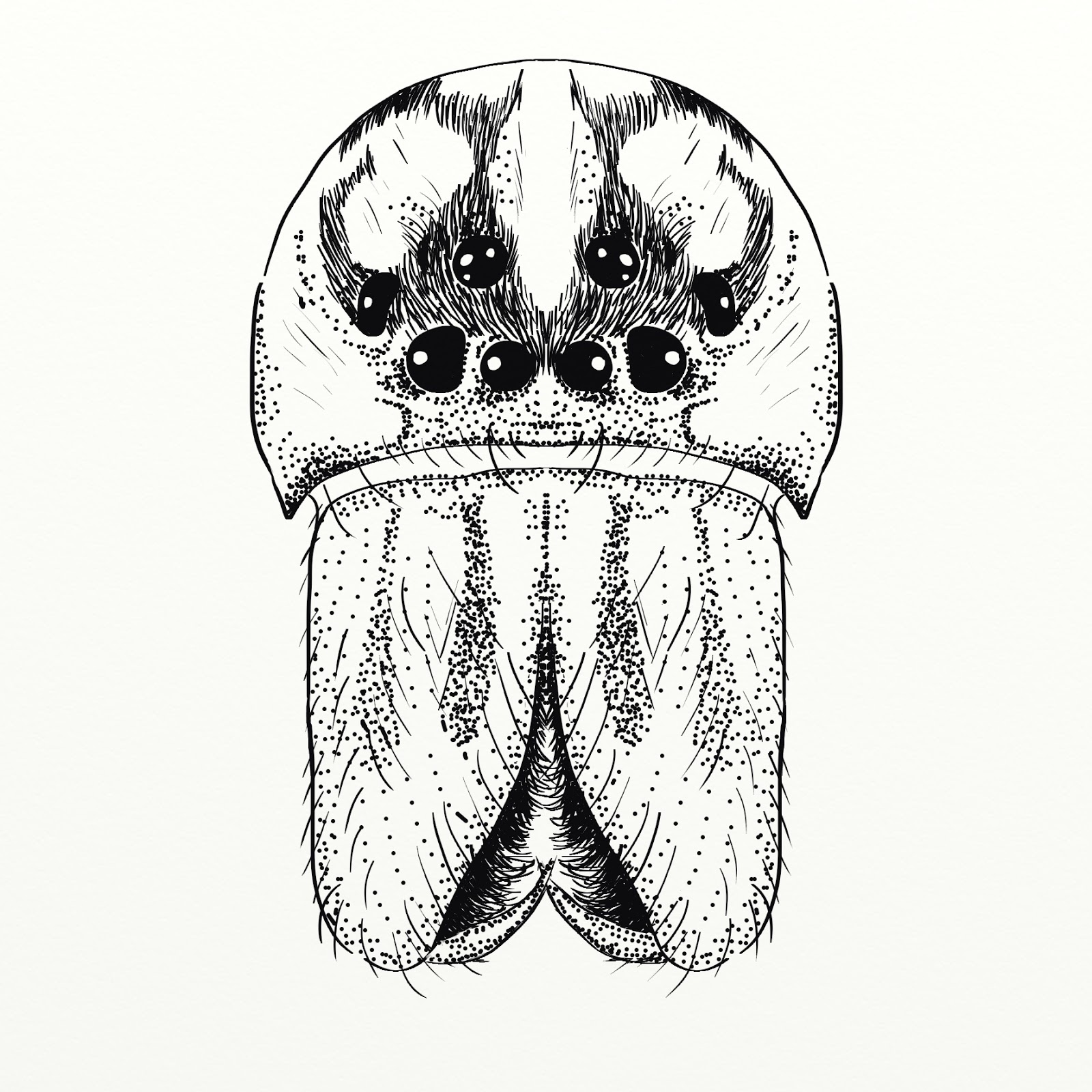
Liocranidae: spiny-legged sac spiders

Credit Gerhard Elsner CC BY 3.0 via Wikimedia Commons.

A small family with 13 British species that used to be regarded as part of Clubionidae. They are mainly nocturnal wandering hunters, except the two species of the genus Phrurolithus, which are diurnal ant mimics, and have been also regarded as a different family.

Distinctive egg sacs
Some Agroeca have distinctive stalked egg sacs, like inverted wine glasses (top shot), sometimes covered with soil, which are seen more often than the spider, as they are not guarded. Other species guard their egg sacs.

Parasitoids
Spiders have many species of external and internal parasitoids, most of them ichneumonid wasps. Some external parasitoids attach themselves to adult spiders and feed on them, other species search for cocoons and inject their eggs on egg sacs, with the parasitoid larvae developing on the eggs. The characteristic egg sacs of Agroeca makes them easy to identify and collect, so in a study of spider adult and egg sac parasitism in Germany, up to 66% of Agroeca egg sacs were parasitised. Four species of parasitic wasps emerged from egg sacs: two small Gelis wasp species, Bathythrix formosa, and Thaumatogelis audax. Few or no spiderlings emerged from the parasitised egg sacs, indicating how important parasitoids can be as a source of spider mortality.

More information
Finch, O. D. (2005). The parasitoid complex and parasitoid‐induced mortality of spiders (Araneae) in a Central European woodland. Journal of Natural History, 39: 2339-2354.

Wednesday, 28 October 2015

Anyphaenidae: buzzing spiders

Credit gbohne, CC BY-SA 2.0, via Flickr.

A mainly American family with a single UK species, Anyphaena accentuata, that can be recognised by arrow head markings on the abdomen. They are good climbers that live on the foliage of trees in woodland and scrub, where they hunt and mate. They are active hunters that pounce on insects that sit on leaves such as leafhoppers, aphids and flies.

Buzzing spider
Males of this species (top shot) use acoustic cues in courtship, vibrating the abdomen and tapping with the palps while sitting on a leaf. This produces an audible noise (which may be undetectable for older people), so Bristowe suggested the name buzzing spider for them. This is a short clip of this behaviour. Females may respond to these signals by approaching the calling male. Females attach their egg sac to the underside of leaves and guards it in a thin silk cell.

Cold adapted
Immature buzzing spiders are active year round and have physiological adaptations to activity during cold temperatures, even below the freezing point. In the winter they prey on small insects that live on bark.

Tuesday, 27 October 2015

Dictynidae: mesh weavers

Credit: Drriss & Marrionn CC BY-NC-SA 2.0 via Flickr.
These are small cribellate spiders, less than 5 mm long, some with characteristic colour patterns. They build an irregular sheet web usually with a central retreat. Many of the 18 British species are uncommon. Some of the species live on plant foliage, others are ground dwellers.
 The top shot shows Nigma walckenaeri a green and white spider that builds sheet webs on the top surface of leaves. This species is mainly found in the Thames and Severn valleys, where it can be common in gardens.

'Unusual friendship' between males and females
 Dyctina arundinacea, the most common species, makes its web atop a dead shoot or flower head. The spider adds more threads as the summer progresses, for, unlike orb weavers, the web is a permanent structure. Bristowe remarked that in this species, the male spends an unusually long time in company of the female in her web (a month or more). Once a male enters a receptive female's web, he signals to her and she signals back with vibrations and tactile signals. The male then goes on to modify the female's web and adding threads to build a canopy, where mating happens. They signal to each other every time they meet. Males and females can even share capture and eating of prey. The female sets her egg sacs inside the web, and she can produce up to six in a season. While a male have to gain from staying around a female, for example, preventing rival males from mating with 'his' female, it is unclear what the female has to gain from accepting the male, unless his cooperation in prey capture helps she build up resources for egg production. More research is needed on these spiders natural history. There are tantalising observations of  males possibly participate in egg guarding. Some non European Dictynidae are social, so it is possible that the roots of social behaviour lay on these unusual male-female associations.

Monday, 26 October 2015

Zodariidae: ant spiders

Credit: Christophe Quintin, CC BY-NC 2.0 via Flickr.
This relatively large family is distributed mainly in tropical and warm temperate regions. There are four species in the UK, all from the genus Zodarion, and all of them appear to be recent arrivals with first records from 1979 onwards, although there have been suggestions that at least one of them is native. They are very local and tend to be found in the south of England where they live in dry, warm and open habitats in association with ants.

Ant-looking ant-eaters
Spiders of the genus Zodarion are ant mimics: they resemble ants in size, shape and also behaviour. The resemblance goes as far as the microscopic pattern of spines, bristles on legs, cephalothorax and abdomen as ants. Even the effect of a shiny ant body is achieved with ridges in their cuticle. They also imitate ant gait and tactile signals: they deceive ants by tapping with their first legs, as ants do with their antennae. Mimicry is thought to offer them protection from spider predators that avoid ants. But they are also aggressive mimics: they use the resemblance to ants to approach unnoticed, as they feed exclusively on ants, using ambushing tactics. Once they capture an ant, they hold its body ahead of them and present it to approaching ants, a behaviour known as 'shielding', at the same time tapping the antennae of the ant. This way they imitate the behaviour of ants carrying dead corpses away from the nest.

Igloo makers
When resting the spiders take shelter in curious igloo-shaped refuges made with small pieces of debris and tiny stones (see photo below). They also lay their eggs in their retreats.
Credit: Korenko S, Schmidt S, Schwarz M, Gibson G, Pekar S , CC BY 3.0, via Wikimedia Commons.

Sunday, 25 October 2015

Cybaeidae: water spiders


Credit: Norbert Schuller CC BY-SA 3.0 via Wikimedia Commons

The only British species in this family, the Water Spider Argyroneta aquatica, is the only known spider that lives almost permanently under the water surface. It inhabits clear ponds, ditches or slow moving streams. Despite their ability to dive and swim freely, their adaptations for aquatic life are subtle: the fine hairs of their abdomen and front of cephalothorax trap a silvery lining of air when the spider is under water, and the two pairs of rear legs are covered with rows of long fine hairs, which help with swimming and collecting air bubbles. They are grey and brownish spiders that can reach large sizes (sometimes over 2 cm).

Inside diving bells
The water spider builds an underwater refuge made of a dome of silk attached to submerged plants which she fills with air. This takes several trips to the surface, trapping large air bubbles with the aid of her rear legs, and then releasing the air out when she is under the dome. The dome then acquires a bell shape and effectively acts as an external gill. The spider spends much of its time in the bell, as oxygen diffuses from the water into the air bubble as the spider uses it up. Moulting either takes place inside the bell or on the water surface.

Reverse size dimorphism
Unlike most spiders, water spider males are on average larger than females. This could be due to the different hunting strategies of males and females: males are more active hunters and spend more time diving outside their bells, and large males are better divers than small ones in moving inside water as they are better counteracting air buoyancy. Females build larger bells and, in contrast to males, tend to practice ambush hunting from their bells, sitting head down with her front legs by the entrance, where they can detect vibrations of passing prey. Both males and females take their prey to their bells to eat.

Reproduction
Mature males (top shot) leave their bells in search for females. Mating takes place in the female's bell, although it involves both male and female swimming outside the bell. When mating, females prefer larger males, but they are also more wary of them, as - also uniquely to them - male water spiders are known to occasionally cannibalise females (although the reverse also happens). Females sometimes lose their bells after rejecting a male.
The female lays her eggs in her bell, in a thick white egg sac at the top of the bell. She partitions this area out with silk and remains in the bottom part of the bell herself. She stays there on guard until the spiderlings hatch. After a few moults they disperse and they quickly build their own little bells under water. Females can lay several egg clutches in a season.

Empty snail shells
At the end of autumn, the spider reinforces the bell with more silk, closes it and stays in it through the winter months. An alternative winter home are empty pond or ramshorn snails, lined with silk and filled with an air bubble.

More information
Schütz, D., & Taborsky, M. (2003). Adaptations to an aquatic life may be responsible for the reversed sexual size dimorphism in the water spider, Argyroneta aquatica. Evolutionary ecology research, 5, 105-117.

Schütz, D., & Taborsky, M. (2005). Mate choice and sexual conflict in the size dimorphic water spider Argyroneta aquatica (Araneae, Argyronetidae). Journal of Arachnology, 33, 767-775.