Sunday, 27 June 2010

More on Fork-Tailed Flower Bees


I had a super A. furcata watching day in my local wildlife garden today. In a beautiful large patch of flowering Hedge Woundwort (Stachys sylvatica), in the shade, a male (below) kept patrolling, checking every flowering spear visually and darting between them, stopping to feed occasionally.
Two females collected nectar and pollen, at times both together in the same spear. The male came across and pounced a couple of times on a female, but I saw no copulation. Males seem to have a similar patrolling behaviour around favoured flowers as A. plumipes. In my garden it patrols different flowers around it (Iris, Digitalis lutea and D. purpurea). But last year I planted their local native favourite plant, S. sylvatica in a shady corner. Although it is still small, it is now flowering. Something interesting is that these bees do not mind shade or cloudy weather, they will be out and about like bumblebees whatever the weather, so they don't tend to overlap with sun-loving Anthidium manicatum - which has a similar flower choice than them and males aggressively defend territories - so much when they forage. I wonder if they are able to thermoregulate in a similar way than their relative A. plumipes and this allows them to exploit a different niche to other summer bees.
An Anthophora furcata female with legs full of pollen foraging in Stachys sylvatica.

National Insect Week Gallery

I have been too busy writing down stuff I've been watching or compiling records, and generally watching bugs these last warm days to blog, but I have decided to put an end to this by celebrating National Insect Week (21-27 June) with a gallery of the bugs I have been watching. I hope you enjoy them.
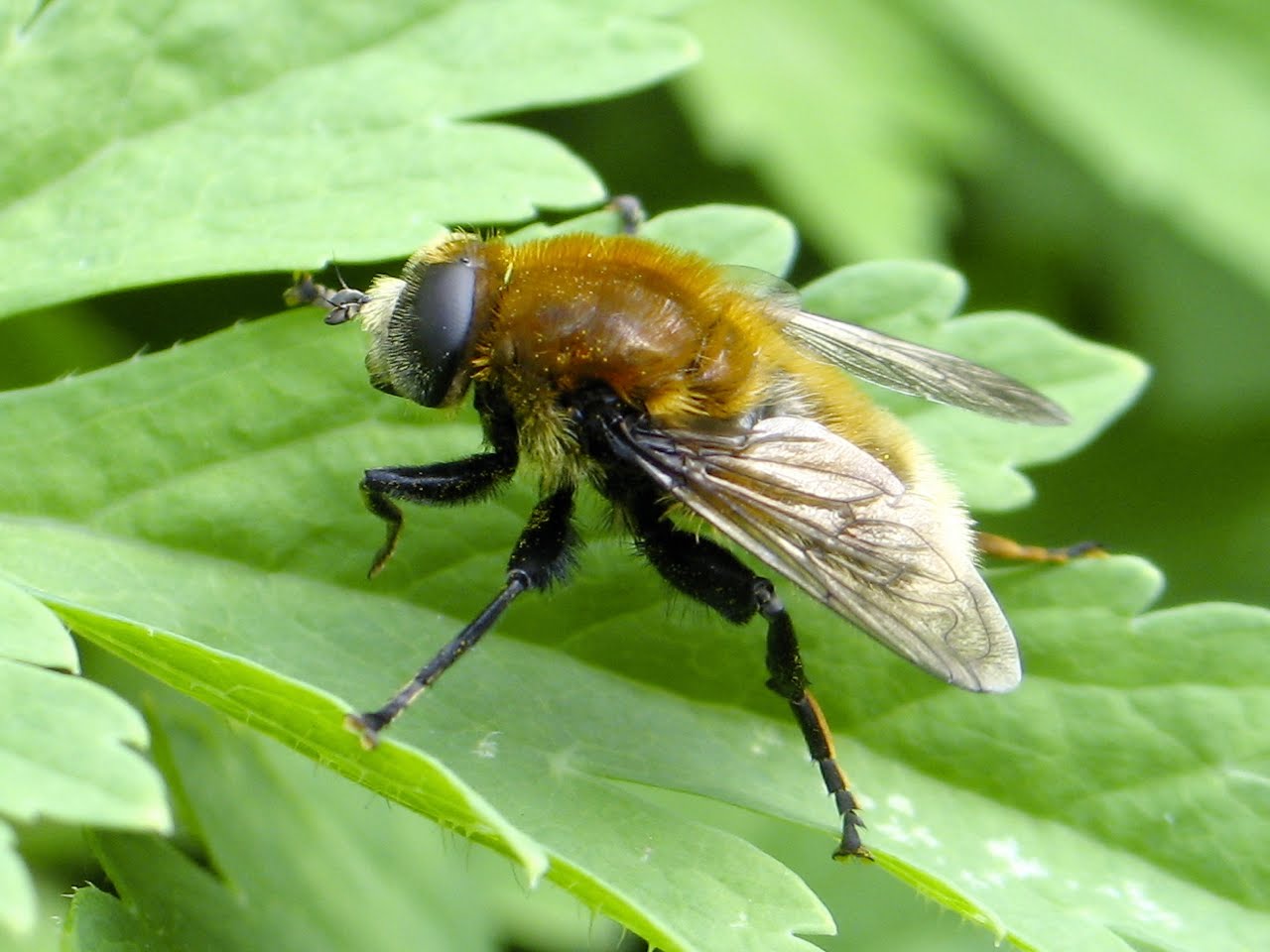
Flies: This is a large hoverfly, Vollucella pellucens. I have been watching them today hovering and I tried in vain to get a good shot in flight. This one posed nicely for me though.
 Bees: I had a great time watching Anthophora furcata in my local wildlife garden. This female is gathering pollen from Stachys sylvatica.
 Butterflies: the first ringlet of the year. It was warm and this individual fluttered for quite a while before settling on the grass.
Moths: yesterday I spotted this Narrow Five Spot Burnet atop a Knapweed seed head.
And more bees: After cutting a piece of Circaea luthetiana, this female Leaf-Cutter Bee (most likely Megachile centuncularis) had to retreat and alight again as it couldn't fight the wind carrying the piece of leaf. After a while, it flew away to her nest.
A sunbathing Wool Carder Bee (Anthidium manicatum) female.
Beetles: A female Lesser Stag Beetle walking over some plants on a front garden yesterday. So far, I have only seen females in Hull.
More bees: A Bombus hortorum extends its long tongue before landing in a Digitalis lutea flower. This is the longest-tongued bumblebee in the UK.
A male Colletes daviesanus resting on an Oxeye Daisy flower and...
a female with loaded pollen baskets nearby.
To end, another bee (of couse) a female Anthidium manicatum feeds on a Geranium flower on the summer solstice.

Wednesday, 16 June 2010

Daddy long legs vs bath spider

I got this shot yesterday, having missed the action under the kitchen units. A Daddy long leg spider (Pholcus phalangiodes) holding a Tegenaria (the common 'bath spider') well secured with lots of silk. Judging by the prey residues I come across, Pholcus often hunts spiders - and woodlice. I have never seen them hunting through, they mostly sit patiently on their corner, waiting for prey to bump into them.

Tuesday, 15 June 2010

Flies on costume

A Bombus lapidarius flies by, and stops to sunbathe on a leaf...but, wait a minute!, bumblebees industriousness clashes a bit with this behaviour, and I have a second look. Doh! it's not a bumblebee, but a mimic: the large, colourful and furry hoverfly Merodon equestris. It is easy to be fooled. This individual is all black, with a bright red tail. The costume is so good, you can't stop watching: even the back femur is thicker like its mimicking the bee's pollen baskets! And it gets more fascinating still: Merodon equestris is highly polymorphic and different individuals colour patterns mimic different bumblebee species. Earlier in the month I came across one looking like Bombus pratorum and another like Bombus pascuorum. The different forms are actually just colour morphs that interbreed with one another, as shown in one of the photos below. Some of the colour patterns are sex-specific, that is, they are always male or female (the 'lapidarius' looking form is always a female). This fly can be found from April to September, but it is most abundant in May-June. The species is native from southern Europe and is thought to have been introduced in the UK from the continent - where it was first recorded in 1869 - in shipments of flower bulbs, on which the larvae feed, hence its common name, Large Narcissus Bulb Fly
Imitating Bombus pratorum
This male looks a bit like B. pascuorum
Two colour forms mating on the side of a pot.

Monday, 14 June 2010

Ants as scavengers and herders

So far I have overlooked two important aspects of garden ant foraging behaviour, mainly due to the lack of suitable photos. Yesterday, I spotted a strange large insect walking on the concrete yesterday, when I got closer I realised it was actually a dead bluebottle being dragged by a garden ant (Lasius niger). Another ant run frantically back and forth, but a single one seemed to do most of the work. The strength of an ant is quite formidable, able to lift or drag objects much heavier than themselves. This illustrates the role of ants as scavengers. Any dead animal will either be dragged to the nest or bits of it will.
The second aspect is one of the most surprising of ants - showing their adaptability -  but also a reason why they are hated by many gardeners: their role as aphid herders. Ants behave as farmers with their aphids and will try to keep the numerous aphid predators at bay as well as milking their honeydew. This is considered a mutualistic relationship and aphids also benefit from the behaviour. Even when aphid predators are excluded, aphids multiply faster in the presence of ants. The photo, taken today, shows two garden ants stimulating Elder Aphids (Aphis sambuci) to excrete their honeydew. Elder aphids form very compact groups on tender growing stems of Elder.