Wednesday, 30 September 2020

Hull Dragons 2020: September summary

Autumn is definitely on the air, after the warm and sunny days that have brought the dragonflies and damselflies out in the first three weeks of the month, cooler weather with northerly winds and more rain set in for the last part of the month. A total of 133 records from 8 species were submitted in September by 15 observers, covering 31 km2. Thank you all for your efforts. The survey is set to surpass the number of records submitted last year, with a total so far of 696 records. 

March of the Willow Emerald
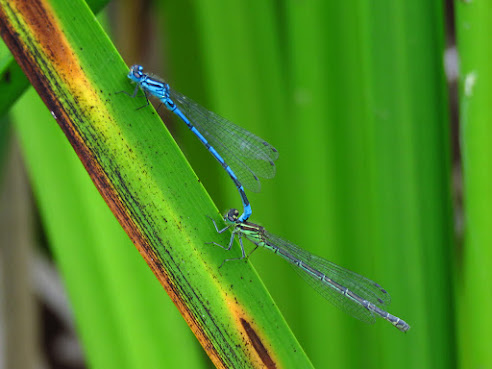
The Willow Emerald Damselfly has expanded through the UK since 2009, after natural colonisation from Europe. A year ago Dick Shillaker found a male Willow Emerald at East Park, the first record for East Yorkshire. This year, we've had a number of records for the species in the Hull area, in fact, it has been the 3rd species in number of records for September after Migrant Hawker and Common Darter. A warm, breezy afternoon - one year to the day of the first record - I bumped into a mating pair, first flying and then settled on a buddleia branch, just under the pedestrian bridge at Abbey Way, over the Beverley & Barmston drain (top shot). Some distance away, a lone female basked on a Japanese Knotweed. A few days later, we had another set of records at a new location, Humber Bridge Country Park, where 6-7 individuals with two mating pairs in the same area and records for a number of days. A male was spotted at the Beverley and Barmston Drain by Beresford Avenue. The sudden increase in records from last year and their spread, and the number of individuals involved may suggest that the species may have been overlooked last year, when it might already have bred in Hull. Alternatively, there has been a massive influx of individuals arriving at suitable sites coinciding with the warm weather and southernly winds?
Female Willow Emerald Damselfly on Japanese Knotweed.

Beverley and Barmston Drain
I have been visiting the Beverley and Barmston drain regularly this year. It has been surprisingly good for dragonflies, with even a Hairy Dragonfly early in the year. The drain does looks like ideal habitat for Willow Emeralds: very slow flowing and with occasional willows over the water. 
A terrapin emerges from the blanket of duckweed
Moorhen sat on floating rocking horse.
A stretch of drain with overhanging willows.
This stretch of the drain has large trees on one side.

Abbey Way pedestrian bridge.
Beresford Avenue bridge.
Breeding Migrant Hawkers
September is peak breeding season for Migrant Hawkers. They reach maturity and males develop intense blue and yellow colours. Females also have more rich brown and yellow colours. Individuals may still be seen away from water, but as they mature, they are increasingly found by their breeding lakes and ponds where their behaviour becomes more focused on breeding. Males patrol areas by marginal vegetation, often hovering over this for some seconds before moving to prospect another area. Sometimes they enter marginal vegetation searching for females. If a female is spotted, mating ensues. I have been able to follow two mating pairs from the beginning. The pair flies away from the water and settles on trees or marginal vegetation, on a south facing spot. Although I've watched many pairs mating, in two instances I could watch a mating pair for a long time, since the initial capture of the female by the male. These two pairs remained mating for over 32 minutes and over 17 minutes (I didn't stay the full length of the mating so these will be underestimates). I have been unable to find any information on the average mating length in the species. In a previous post I have covered the mating system in this species, which concludes that non-territorial species, like the Migrant Hawker, where sperm competition is likely to be more intense, mate for longer, and is nice to see that my observations match this expectation.
A resting male in full breeding colours.
Mating pair at Noddle Hill lake.
Migrant Hawker ovipositing on floating branch at Foredyke Green Pond, an unusual ovipositing spot for this species.
Female Migrant Hawker ovipositing on branched burr-weed leaves, by the water. 
Brown Hawker ovipositing on floating wooden board.

Species recorded in September

Migrant Hawker, 74 records.

Common Darter, 30 records.

Willow Emerald Damselfly, 11 records.

Southern Hawker, 6 records.

Small Red-eyed Damselfly, 2 records.

Blue-tailed Damselfly, 1 record.

Ruddy Darter, 1 record.

Brown Hawker, 1 record.

Wednesday, 2 September 2020

Hull Dragons 2020: August summary

We've had some excellent dragonfly weather this August, with plenty of warm, sunny days. Although the last week had plenty of wind and rain, it was often warm enough even when overcast to entice some dragonflies out, until the very end of the month, dominated by cold northerly winds.

Odonata highlights

We've got a whooping 200 records from 12 species in the month of August. These are from at 35 1 km squares for August from 13 recorders, thank you all who have contributed records!

The season is over for many species (Hairy Dragonfly, Large Red Damselfly, Broad-bodied Chaser, Banded Demoiselle), and is coming to an end for others: Azure Damselfly, Four-spotted Chaser or Black-tailed Skimmer.

Migrant Hawkers (top shot) have been the top species, with a third of all, followed by Common Darter,and Blue-tailed Damselfly. Although there has been no new species added for the year in August, there is a chance we may still record Willow Emerald as the first records las year were in September.

Brown Hawkers

Brown Hawkers bumper year has continued, they are the 5th species in number of records for the month. In July many observations involved patrolling males on territory, but in August, ovipositing has been observed, twice at Foredyke Green (on the muddy shore, on floating wood and on floating polystyrene) and also likely ovipositing behaviour at East Park.
Female Brown Hawker rests between ovipositing bouts.
Oviposition on polystyrene.

Migrant Hawker

Most records involving hawkers away from water, hunting at 4-5 m high, sometimes in twos and threes are highly likely to be Migrant Hawkers in our area. Two or three individuals have been present regularly in my garden, and I was lucky enough to spot one of them basking quite low on a potted olive tree. It allowed for very close approximation.
A male Migrant Hawker Photo taken by my son with his mobile phone. 22nd August.
And a female, from the 31st of August.
There were several exciting Migrant Hawker highlights. One of them was to find a total of 6 exuviae at East Park. Exuviae is the formal name for a moulted larval skin, which can be found on marginal or emergent plants, after the adult has emerged. The presence of exuviae in a site provides evidence that a species has successfully bred in a site. As far as I know this is the first confirmation of successful breeding in the city of Hull after last years observed ovipositing in several sites.
Migrant hawker exuviae in situ.
Another interesting observation involved an individual flying underneath an ivy overhang and settling on it, moments before a rain shower. I found another individual near it. I wonder what makes the hawkers seek refuge, maybe the sudden darkening of the sky?


I was at Pearson Park Wildlife garden during muggy, but cloudy weather. During a sunny spell followed by a strong breeze, at least 20 migrant hawkers took to the wing and started hunting over the garden. This is the largest number of individuals I have seen of this species.
Finally, I have been able to observe Migrant Hawkers active during cloudy weather and temperatures as low as 13-14 oC. They might be able to achieve temperatures high enough for flight by basking during brief sunny spells. When windy, they forage around trees at the lee side of the wind in sheltered, sun-facing spots.

Blue-tailed damselfly mating behaviour
The following photo show a mating pair of Blue-tailed damselflies. In this species, copulation is very long, up to 8 hours and in dense populations a form similar in colour to males increases in frequency, as these females avoid the costs of prolonged copulations.
Females oviposit alone. I was at Foredyke Green site about to take a photo of an ovipositing female, when a male came out of nowhere, knocked the female over, and immobilised her by holding her with jaws, legs and mating appendages. The following is a series of photos documenting how the male gains hold of the female, in the last photo he has already adopted the tandem position. I wonder had I only seen the last part of the behaviour, with the female already on the water, if I would have concluded that this was an example of a 'damsel in distress' being rescued by the male. I'm glad I got the whole sequence!

Small Red-eyed Damselfly

The Pickering Park and East Park populations are thriving: hundreds of individuals were present at East Park model boating lake and some as well in the main lake. A record in a new location was at St Andrews Quay Pond. The records show a establishment of the species in both large parks at Hull. Copulation and ovipositing was observed at East Park and Pickering park.

Small Red-eyed Damselfly at Pickering Park.
Small Red-eyed at East Park.
Copulating Small Red-eyed damselflies at East Park.

Best sites this year so far:

  • East Park: 13 sp.
  • Noddle Hill LNR: 12 sp.
  • Foredyke Green Pond 11 sp.
  • Oak Road Lake 9 sp.
  • Pickering Park 8 sp.
  • St Andrews Quay Pond 8 sp.
  • Beverley & Barmston Drain 7 sp
  • Paull Holme Strays 7 sp.
  • Humber Bridge Country Park 7 sp.
  • Pearson Park Wildlife Garden (closed due to COVID, but surveyed with permission) 6 sp.
  • Willerby Carr Dyke, 6 sp.
  • Beverley & Barmston drain, 6 sp.

Other species Gallery

Teneral Common Darter.
Common Darter in obelisk position
Emerald Damselfly at Noddle Hill LNR.
Ruddy Darter at Noddle Hill NR.
Southern Hawker at Noddle Hill LNR
Ovipositing Emperor at Foredyke Green pond.
Common Blue Damselfly.
A late Azure damselfly. Numbers have been steadily falling during the month of August.

Wednesday, 12 August 2020

Common garden damselflies and dragonflies in the Hull area

Although a total of 23 species of dragonflies and damselflies have been recorded in Hull, only a subset of them can be considered regular in gardens, and a few species will even turn up in gardens without a pond. Here, I will present seven of the species most common in gardens, with identification tips. These species provide a useful benchmark to help you to identify rarer dragonflies and damselflies when in other habitats.

Damselflies
Two species of damselfly are common in gardens, where they regularly breed. They are even tolerant of fish, provided there are areas of thicker vegetation where their larvae can seek refuge, and will be even present in ornamental ponds with hard edges. Both are blue and black. 
1. Azure Damselfly
The Azure Damselfly gives an all vivid blue impression, it has a distinctive black hook or spur pointing forward on the side of its thorax, which distinguishes it in our area from the Common Blue Damselfly. I should have said males are all blue, as females are often green and black, as in the photo above. They can be found even in tiny garden ponds, provided they have plenty of vegetation near or in the pond. It flies from early May to early August.
2. Blue-tailed Damselfly
The Blue-tailed damselfly is the most common species recorded in Hull. It tolerates of all sorts of conditions: brackish ponds, polluted ponds, fish, and even poor weather! It  It has been described as a 'flying magic wand', as its black abdomen contrasts with the blue band near the tip. It has a distinctive two-colour wing spot, which is useful to identify females, which come in 5 different colour forms. It has a long flying season, from late April to late September.

Dragonflies
3. Broad-bodied Chaser
This is a stunning dragonfly, the immatures are yellow and brown, with dark wing bases and a characteristic wide abdomen. In flight it is very reminiscent of a hornet. Mature males develop a powdery blue colour in their abdomen. This is a species likely to use newly built ponds, or ponds with plenty of bare or muddy margins. They fly early in the season, from mid May to mid August.

4. Migrant Hawker
This is the most common hawker in Hull, and is regularly found in gardens away from water. The individual pictured is a mature male, but it is immatures that are commonly found in gardens, and these have subdued colours and milky eyes. They tend to fly in the open at 3-5 m high, often going round and round in a relatively small area. It tolerates other individuals, which will congregate in gardens with plenty of food. It flies from late July to late October or early November. Although plentiful in gardens during their immature stage, they tend to breed in lakes and ditches. 
The usual view of a flying migrant hawker over a garden.


5. Southern hawker
A large colourful hawker, one of the most strikingly marked. The combination of apple green and blue markings in mature individuals is characteristic, as their habit of being curious towards humans, flying close as if checking you out. It tends to hawk close to the ground alongside paths and close to tree canopies, often in shaded, sheltered places. Females will lay eggs on floating wood or marginal vegetation in relatively shaded ponds. It has a long flight season, from mid-June until October.


6. Common Darter
A small dragonfly that hunts from the ground, or a perch, to which it returns. Immature individuals are yellow, but males become orangey-red, with two yellow panels on the side of the thorax. All individuals have a thin yellow stripe alongside their legs. One of the most common dragonflies. It can breed in garden ponds of medium or large size and including ornamental ponds. It has a long flight season, from June until November.

7. Ruddy Darter
The Ruddy Darter is less common than the Common Darter. It prefers to hunt from a perch, or from the ground, to which it returns after catching prey. Males have a more intense red than the common darter and a more waisted abdomen. Immature individuals and females are orange/yellow. The legs in both sexes are black. Flies from mid June to mid October. It breeds in ponds with plenty of marginal vegetation, although it can roam, and can be found in gardens away from ponds.

More information
  • If you are interested in identifying dragonflies and damselflies, Yorkshire Dragonfly Group has plenty of information on all the species and interesting sites to visit and runs an active Facebook group.
  • If you have any dragonfly records from your garden in the Hull area you can either submit the record to iRecord, or message me in the blog comments or on Twitter.
  • For more information on Hull Dragonflies and damselflies you can read the City of Dragons 2019 report here.

Saturday, 1 August 2020

Hull Dragons 2020: July summary

The first three weeks of July had very changeable weather, with plenty of overcast, muggy weather and some showers. Sunny spells were few, short and far between until the last week, where we enjoyed a few days of warmer, consistent sunny weather. 

Odonata highlights
Records were initially slow coming in July, but overall the month had a total of 144 records from 15 species have been submitted by 10 recorders from 23 km2, a few more than in June. As expected, the Blue-tailed Damselfly tops the list in terms of numbers of records, followed by the Emperor Dragonfly, and the Common Darter, with the same number of records. The surprise is that the Brown Hawker is tied 4th with the Azure Damselfly, with 11 records, more than were recorded during the whole of last year. The year total so far stands at 18 species.

First records of the year
  • Ruddy Darter, 11th July
  • Common Darter 11th July
  • Emerald Damselfly 19th July
  • Brown Hawker 12th July.
  • Migrant Hawker, 24th July
  • Small Red Eyed Damselfly, 25th July
Emperor behaviour
Emperors seem to be having a good year at the recording area. I've had a great time watching the behavioural differences between males and females. Males are a very showy dragonfly, 'presiding' over their territory, a pond, lake or a stretch of ditch, flying powerfully, over the open water, occasionally hovering on a spot, rising to catch an insect or flying over the banks, even checking birds flying past (I watched a brief Swallow-Emperor face off, both flying away!). They are always pulled back to the water, unlike other hawkers. At some point, they stop their hunting and patrolling to bask or finish a meal, usually on marginal vegetation facing the sun, but also rarely on the ground.
An emperor resting on the ground is an unusual sight. It is likely that it was sheltering from the wind.
Female's behaviour is completely different. They approach the water stealthily, flying low and near the shore, searching for oviposition locations (sticks or floating vegetation). They can be as colourful as males, as the following photo shows. If a male discovers a female, she will try and fly higher than him, curling her abdomen down in a signal of rejection. I've never witnessed a copulation in this species.
Ovipositing Emperor at Foredyke Green Pond. 
Male Emperor at Pickering Park. 
Pickering Park lake is large enough for several Emperors, but the northern side of the pond seems to be the most attractive and it is a place that year after year allows me to see males chasing and clashing for territory. In this case, one of the males landed in the vegetation to rest, while the other one carried on the patrolling. Ovipositing was also observed in the same area of the park. Ovipositing in July was also observed at Noddle Hill Lake, and Foredyke Green Pond.

Watching Brown Hawkers
Brown Hawkers are also having a good year. Four were seen hunting along rides and paths at Noddle Hill nature reserve. At the Beverley and Barmston drain near Beresford Avenue, I watched one for 20 minutes as it hunted repeatedly flying up and down the drain. It took advantage of the light breeze to glide back, then flew powerfully upwind, checking every passing insect, releasing some that were not of his taste. I was slightly amused as the hawker checked every passing creeping thistle seed (just like me!), and there were plenty floating in the breeze. I was hoping the Brown Hawker will have a rest at some point, but it didn't. Its territory-  and it was a male - was 20-30 meters along drain, with plenty of emergent and floating vegetation and a hedgerow on one side by the allotments. It flew high over the water, maybe over 1 m high, and then occasionally charged against the marginal vegetation, possibly to dislodge resting insects. Although I've got no photo opportunities so far, I enjoyed watching the species behaviour from a great vantage point.

Species gallery
Four-spotted chaser at Foredyke Green Pond.
Teneral Southern Hawker at Setting Dyke.
An Azure Damselfly rejects another's advance.
Blue-tailed Damselfly.
Teneral Common Darter at Pickering Park.
Common Darter at Midmeredale Pond.
Mating Blue-tailed damselflies at Pickering Park (note that the female is the same colour as the male, they are known as androchrome females).
Emerald, one of two males at Noddle Hill NR.
Small Red-eyed Damselfly at Paull Holme Strays. A mating pair was observed at Pickering Park.
A record shot of my first Migrant Hawker this year.