Showing posts with label dispersal. Show all posts

Monday, 30 July 2018

Small Red-eyed Damselfly range expansion

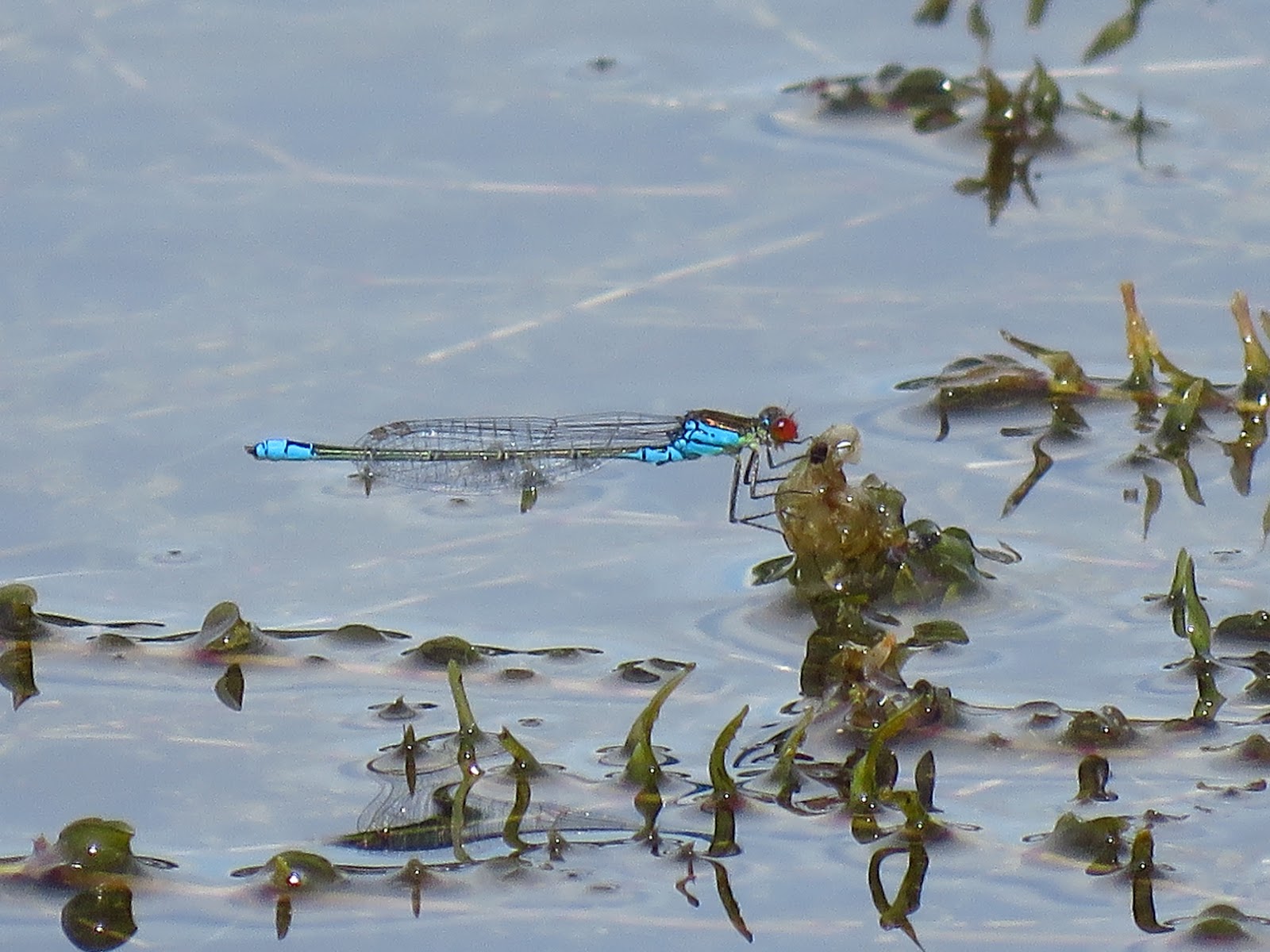
This morning I watched several males of the Small Red-eyed damselfly at North Cave Wetlands, a YWT nature reserve with a diversity of large lakes, shallow reed bed lakes and dragonfly ponds (top shot). It was the first time I see this species in this site, where is now established. The Small Red-eyed is quite a distinctive damselfly, but it can be confused with its relative the Red-eyed Damselfly. The Small Red-eyed has an later flight season (end of July-August, although they do overlap), is smaller, has more blue in the tip of the abdomen and tends to sit with the abdomen curved upwards. Both species like to sit away from the shore, on floating aquatic plants, and individuals come back to the same spot after hunting. Given their habits and small size binoculars are a must to identify it!
Female Small Red-eyed Damselfly at Clubley's Scrapes (Spurn NNR, 21/07/18)
 The Small Red-eyed has been a British species for less than two decades. After a range expansion within Europe culminating with the colonisation of the Netherlands and Belgium, the species was first recorded in coastal sites in the south of the UK in 1999 and rapidly expanded north and west at a pace of 28 km per year. Today it is present up to North Yorkshire, but the rate of expansion is reducing. In 2006 it was first found in East Yorkshire, in a fishing lake in Hull, Oak Road Lake, and now it is present in several East Yorkshire sites.
 Colonisation can be associated with loss of genetic diversity, especially if the species in question is a poor disperser or population growth is slow after establishment. Given the speed and recency of colonisation of the Small Red-eyed Phillips Watts and colleagues investigated the genetic relationship and genetic diversity of nearby European populations and UK ones. It was presumed that the waves of migration came from NW France and Belgium, but there was another colonisation centre in the UK around the Isle of Wight, which hadn't expanded as much. Watts screened Small Red-eyed populations with 10 very variable molecular markers, similar to the markers used in forensics. The Isle of Wight population had less diversity than the remaining British populations, but the populations involved in the main expansion had a similar diversity to European populations investigated, with no evidence of population bottlenecks. This indicated that the waves of colonisation from the continent likely involved large numbers of individuals, and or colonising populations grew rapidly after establishment precluding losses of genetic diversity. Although it might appears surprising that this tiny insect can be capable of long distance dispersal and rapid colonisation, but migration is a increasingly acknowledged feature of many insects.
Small Red-eyed in flight.
Spot the tiny Small Red-eyed underneath an ovipositing pair of Common Darters and a Common Blue Damselfly.

More information
Watts, P. C., Keat, S. & Thompson, D. J. Patterns of spatial genetic structure and diversity at the onset of a rapid range expansion: colonisation of the UK by the small red-eyed damselfly Erythromma viridulum. Biol. Invasions 12, 3887–3903 (2010).

Tuesday, 7 October 2014

Hitchhiker crickets

For about a couple of weeks, my six year old daughter has been telling me about the crickets in her school playground. Crickets? surely they would be grasshoppers, I said dismissively. I shouldn't have doubted her identification abilities, as she confidently pointed at oak bush crickets when presented with photos in a field guide, and my husband and son also confirmed it. I was most intrigued, as bush crickets are rare north of the Humber. Last week I spent an embarrassing amount of time searching for the mystery crickets while the kids played after school, while other parents I know looked at me as if I was going nuts. 'I put in on the tree this morning', my daughter would said, 'I've seen four, no... five' I wondered if the kids throwing sticks to get at the conkers was also dislodging the crickets from the chestnut tree at play time. I searched and searched, and, although I did find some Field Grasshoppers, Chorthippus brunneus, nearby there was no sign of the crickets, so frustrating!

  Today, at school pick up time, she told me she had rescued one from a puddle under the chestnut tree. I searched and initially found none, but finally, I found a live female and a very squished male on the ground, hoorray! Both were collected and taken home, and to my surprise they turned to be the Southern Oak Bush Cricket, Meconema medidionale, distinguished from the related Oak Bush Cricket by its stumpy wings and larger male cerci. Oak Bush Crickets are nocturnal and live in trees canopies, so they are thought to be under recorded, although they are attracted to light, so they turn up inside houses in the summer. Instead of singing by stridulating with their wings like other crickets do, males attract females by drumming with their rear legs on the substrate, and this sound can be audible up to 1 m away. They are predatory crickets, and feed on small insects like aphids and leaf-miners (including those of Cameraria ohridella, the Horse Chestnut leaf miner). Despite their name, they occur in many tree and bush species and are a late species, with adults found from mid August up to the first frosts.

 Since the 1960s, the Southern Oak Bush cricket expanded its distribution range from its original homeland in Italy throughout large areas of Northern Europe, and is now also found in North America. It was recorded in the UK for the first time in the autumn of 2001, and since then, it has spread north up to Nottinghamshire. Given its flightlessness, it is surprising how fast they are expanding. A study systematically searching for this species in the recently colonised Slovak and Czech Republics found that they are found mainly in urban habitats like parks or campsites, often with localised populations near car parks and main roads, suggesting that they might be dispersed passively by vehicles, especially trucks and caravans. They are, unexpectedly, often found on vehicles.

 The fact that several individuals are present suggests that the crickets have been around for a while in the school grounds. Would a teacher returning from a visit down south might be responsible from the introduction of this cricket species in Hull?

The squished male
Side view of the female
UPDATE 8/10/2014
We released the female on the chestnut tree. Although she had lost a leg, she was quite capable of jumping, and hid under a shrivelled leaf. I found a freshly dead male in the same spot, quite intact. Here he is. Look how much longer his antennae are compared to the female.


More information
British Orthoptera & Allied insects page. Here.

Grabenweger, G., Kehrli, P., Schlick‐Steiner, B., Steiner, F., Stolz, M., & Bacher, S. (2005). Predator complex of the horse chestnut leafminer Cameraria ohridella: identification and impact assessment. Journal of Applied Entomology, 129: 353-362.

Vlk, R., Balvín, O., Krištín, A., Marhoul, P., & Hrúz, V. (2012). Distribution of the Southern Oak Bush-cricket Meconema meridionale (Orthoptera, Tettigoniidae) in the Czech Republic and Slovakia. Folia Oecologica 39(2) 155-165.

Liana, A., & Michalcewicz, J. (2014). Meconema Meridionale Costa, 1860 (Orthoptera: Tettigonioidea: Meconematidae)–The First Record In Poland. Polish Journal of Entomology, 83(3), 181-188.

Saturday, 16 June 2012

Girl power: sex and parthenogenesis in Vine Weevils

ResearchBlogging.orgPrecariously perched on a young oak branch, a Black Vine weevil, Otiorhynchus sulcatus, the first of the year. I am really not looking forward to seeing them, but they have an intriguing life cycle, which is key to their success. The Black Vine weevil is a generalist feeder which in the early 19th century was only known in a small area in Central Europe and since then has expanded to much of the world aided by human activities and has become a pest of a range of agricultural and horticultural plants, despite being a flightless, sluggish insect.
 The remarkable thing about them is that all Black Vine Weevils are female. A weevil does not need to find a partner to mate before reproducing, she just emerges from the soil, stumbles to the next suitable patch and lay eggs. The next generation of daughters will be genetically identical to their mum, forming natural clones. Parthenogenetic lineages in general are good colonisers, and expand their population ranges more easily than their sexual relatives. Individuals might disperse the same distance during their lives, but in the parthenogenetic species a single individual can successfully colonise a new patch and establish a new population, while the sexual species needs at least two individuals of different sex - or a fertilised female - and then has to cope with the disadvantages of inbreeding if it succeeds. Most parthenogenetic insect species are flightless, which suggests that parthenogenesis is more advantageous if the insect is naturally a poor disperser.
But there is another card up the weevil sleeve. These beetles are triploids, instead of having the usual two sets of chromosomes (that is, being diploids, like us) they have three. Polyploids are often larger than diploids and may enjoy further ecological benefits such as more resistance to the cold or wider ecological tolerances. Ecologically, parthenogenetic weevils have moved much from their origins in the moist valleys of the Alps, and are now able to persist even indoors, munching the roots of plant pots.
They might not be the most attractive insects, but these weevil story of success shows that appearances can be deceiving and that, sometimes, girls rule.

More information

Lundmark M (2010). Otiorhynchus sulcatus, an autopolyploid general-purpose genotype species? Hereditas, 147 (6), 278-82 PMID: 21166797

Friday, 9 March 2012

Silent aliens

Have a look at these:
Harlequin Ladybird

Lily Beetle

Western Conifer Bug
ResearchBlogging.orgThey are invasive insect species in the UK. They are also so bright, or large, that they are hard to miss. You'll come across them even if you don't look. Many, many other alien invaders are harder to notice, they arrived, and before anybody other than specialist taxonomists noticed, they have spread across sizeable portions of the country. Many such silent invasions involve invertebrates that are small and or hard to identify.
  Clutches of snail eggs in the soil of pot plants, or dormant adults in cracks in stones or other cargo are often sent as inadvertent stowaways across countries thousands of miles away. They arrive in the destination, thrive and begin a quiet invasion. As many snails are tiny, and to the untrained eye they look identical to other snails, they are transported about very often. A sizeable fraction of the snails species of Central Europe is now thought to be of alien origin (about 15%), most of Mediterranean origin and the trend is of a recent increase, aided by increasing temperatures and commerce. In some extreme cases the ability of the snails to disperse is extremely limited, or their requirements for specific substrata so high that they scarcely move after introductions. Such is the case of Papillaria papillaris, a minute snail native of Italy, Sicily and Malta. These snails were likely to have been introduced in the UK in the 18th century with Italian ornaments or stonework, then prized by affluent stately home owners. Just two populations (in Brownsea Island Castle and Cliveden House) have been found so far. Amazingly, they have barely moved a few meters in this time, although they form self-sustaining colonies. Likewise, in Spain, this snail is restricted to walls and ruins from the Roman period, two millennia living practically where they were placed!
 Of course, there are many examples of the other extreme of the spectrum. Species that quickly spread on arrival, or after a lag period. An example is the Girdled Snail, Hygromia cinctella, a snail of Mediterranean origin which now is rapidly expanding in the UK. It was first noticed in the South in 1950, and it has now reached Glasgow, that is fast - for a snail. There have been suggestions that the snail might travel as stowaways in cars! Although this might seem outrageous, snails' habit of climbing up vertical surfaces and attaching itself firmly for aestivation or overwintering might facilitate this and it has been documented that this behaviour increases transport by cars. The girdled snail is 1 cm across and triangular when looked at from the side, with a pronounced keel that sports a pale line. At a distance looks like a juvenile garden snail. My daughter, however, noticed this snail on the pavement in my street a few days ago and it was necessary to rescue it from being crushed by passers by. I only noticed it wasn't a garden snail when I picked it up, after it had retreated into its shell.  I will keep a close eye and see if it has already arrived in my garden.
Side view showing the keel and pale edge.
Underside showing the lack of umbilicus

More information
Burçin Aşkım Gümüş and Henk K. Mienis (2010) Records of Papillifera papillaris affinis in continental Spain and their connection with walls and ruins from the Roman period. The Archaeo+Malacology Group Newsletter, 18: 1-4. here.

Janet Ridout-Sharpe (2010) Papillifera papillaris: a second colony is discovered in England. The Archaeo+Malacology Group Newsletter, 18: 1-6. here.

Alena Peltanova, Adam Petrusek, Petr Kment, Lucie Jurˇicˇkova (2011). A fast snail’s pace: colonization of Central Europe by Mediterranean gastropods Biological Invasions : 10.1007/s10530-011-0121

Tuesday, 5 July 2011

Amber Snail Puzzle

ResearchBlogging.orgWhile removing an old pot containing a lot of grass and a dead Agapanthus, next to a rainwater filled pot, I stumbled upon this little snail. I was quite surprised as initially, I thought it was a pond snail, but closer inspection revealed the tell-tale eyes-on-top-of-tentacles characteristic of land snails and slugs, while aquatic snails have their eyes at the base of their tentacles. After sifting through a Molluscs guide I found out it was a Common Amber Snail, Succinea putris. Although not aquatic, it usually lives near water or in waterlogged habitats, and it is often found on the stems of aquatic plants. It cannot retract its body completely inside the shell, and the lower pair of tentacles is vestigial. I have no idea how this snail got into our garden, but snails, despite being slow and strongly dependent on humidity, are known to disperse widely. In the Origin of the Species, Charles Darwin believed birds were the most common long range dispersal agents of snails and other aquatic animals and plants. In 1893, Harry Wallis Kew reviewed the dispersal of land and water molluscs, and discusses the evidence for external transport on the feathers of birds:
Sir C. Lyell, remarking on the wide range of Succinea putris, a land-shell which inhabits moist places on the borders of pools and streams suggested that water-fowl might have distributed its ova entangled among their feathers and it seems quite likely that ova of certain terrestrial kinds may be occasionally thus carried, either in the feathers or on the feet of birds; indeed, we have a near approach to proof of such transportal, the Rev. Canon Tristram, as we have seen, having once found ova, believed to be those of a Succinea, upon one of the feet of a mallard shot by him, on the wing, in the desert of Sahara. It is doubtful, however, whether Succinea, from the nature of the localities they often or usually inhabit, ought not, for the present purpose, to be classed with fresh-water, rather than with land-shells. Mr. Darwin suggested that the just-hatched young, possibly, might sometimes crawl upon the feet of ground-roosting birds, and thus get transported; and it certainly seems in the highest degree probable that such is the case, but, as far as I know, no observations in support of such a supposition have yet been made.
A tantalizing possibility, also first put by Darwin, is that of internal transport of organisms in the digestive tract of birds. Many bird species feed on snails, and given that no gastric juices occur in bird's crop, they can potentially survive for a while and maybe be discharged later elsewhere by the bird, or regurgitated by raptor if the bird falls prey to it. Kew stated:
 Twenty specimens of a Succinea, peculiarly packed together, and four of Pupa viuscornvi were once found by Mr. W. H. Dikes in the crop of a bearded titmouse (Parus biarmicus); all the shells, it is said, were uninjured, but it is not stated that any were observed lo be alive.
In 1968, Biggs reported on the recovery of a living Succinea putris from a pigeon's crop at least 8 h after the bird had died. Indeed, although it seems even more unlikely, some snails can survive passage through the whole digestive tract of birds provided the shell is more or less unbroken. This has recently been shown to happen to a small estuarine snail, Hydrobia ulvae, which can survive passage through the digestive tract of Shelducks, and also in some small Japanese terrestrial snails, Tornatellides boeningi a proportion of which were recovered alive in the feces of two species of terrestrial bird they had been fed to.
I don't think any of these forms of dispersal apply to the particular little snail in the above photo. Maybe it travelled on a pot plant we bought some time back in a garden centre, or, stuck to our clothes or shoes during an outing into some wetlands. Maybe, but just that any of the forms of transport Darwin and Kew discussed actually happen to snails shows you don't need wings to fly high.

References
Biggs, H. E. J. (1968). Succinea putris (L.) in a pigeon's crop Conchologist Newsletter, 24: 36.
Gerhard Cadée (2011). Hydrobia as "Jonah in the whale": shell repair after passing through the digestive tract of shelducks alive. Palaios, 26 (4), 245-249 DOI: 10.2110/palo.2010.p10-095r
Darwin, C.R. (1959) On the Origin of Species. Read the book here.
Kew, H.W. (1893) The dispersal of shells: an inquiry into the means of dispersal possessed by fresh-water and land Mollusca. K. Paul, Trench, Trübner & Co., Ltd. Read the book here.
Shinichiro Wada, Kazuto Kawakami and Satoshi Chiba (2011). Snails can survive passage through a bird's digestive system. Journal of Biogeography : doi:10.1111/j.1365-2699.2011.02559.x