Showing posts with label Osmia leaiana. Show all posts

Thursday, 16 July 2015

The nest robber

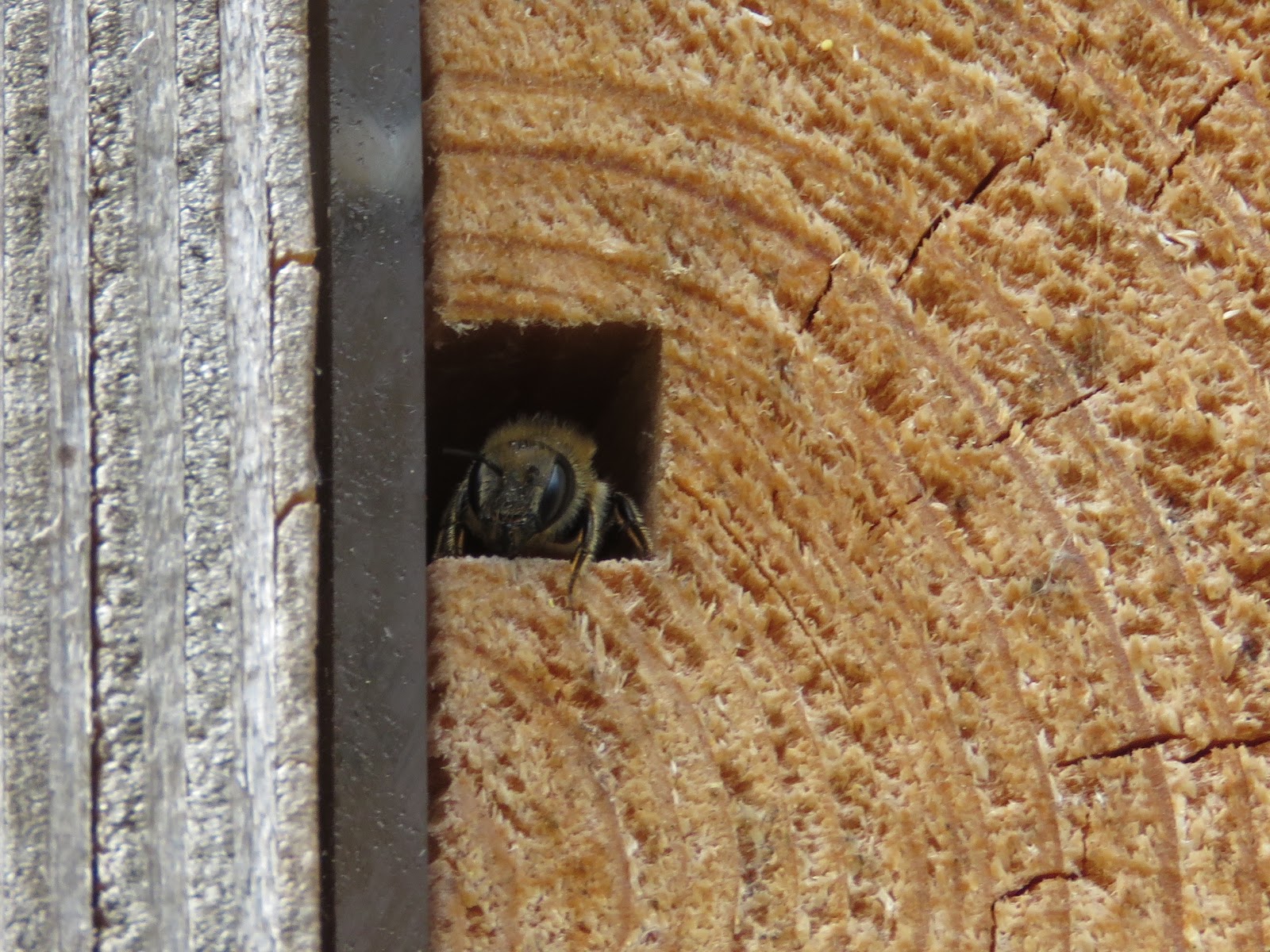
I was puzzled when I checked the bee hotel a couple of days ago. The painstaklingly, lovingly filled nesting cells of the Osmia leaiana nest that illustrated a post a few days ago were gone. There was pollen everwhere and the nest walls made of chewed leaves weren't there. A Megachile willughbiella female, a leafcutter bee, was inside, rubbing its scopa against the walls. Was she the reason for the disappearance of the smaller mason bee's nest or just taking advantage of a previous nest predator?
 Although I'll never know for sure, I think that the leafcutter is probably to blame. There are plenty of empty cavities in the bee hotel, but she apparently decided that this was a better hole than the rest and probably fought the mason bee out of her nest (Leafcutters have formidable scissor-like jaws, and this leafcutter species is a large bee), and then proceeded to empty the contents, eggs, pollen, nectar and walls to make space for her cells. Today, the leafcutter had completed her first cell (above). Note that the walls are still covered in yellow pollen.
 The bee nestbox is providing plenty of surprises and allowing observations very difficult to make in natural holes. The events illustrated here remind me that competition is fierce out there, although in the case of hole nesting bees, it will pass unnoticed in the darkness. Many bumblebee queens are ousted from their nests by other bumblebee queens, not necessarily from cleptoparasitic species, which take over after a fight. In solitary bees and wasps, suitable nest holes might be limiting and intra and intraspeficic competition might be rife, although fights may often take place inside holes. Watch this fascinating video of three bees fighting for a nest hole by George Pilkington, and this series of photos by Simon Saxton documenting two Ectemnius wasps fighting for a nest hole. Nest lining thicker end walls provides physical defence, and might not only protect against cleptoparasitism, but also against other bees taking over, stealing the nest hole and destroying the nest contents.
7th of July. A female Osmia leaiana working on her nest. Note the remains of last year's leafcutters nest in the cavity under it.
16th July, a female leafcutter emptying nest contents by scooping pollen.

Friday, 10 July 2015

A cleptoparasite in the bee hotel


The Red Mason bee is well over in the garden. They have been replaced by their smaller relatives, Osmia leaiana. They have started nesting in the bee hotel and there are several females stocking their nests with nectar and pollen and sealing their nests with chewed up leaves. I removed the side panel of the nest box temporarily to see the progress of the nests. Below is a female with a clump of chewed leaves starting another cell. The yellow lumps are the food supply necessary to nurture one of her larvae to develop into an adult bee.  The bee needs many pollen collecting trips to complete a cell, and then many other trips to collect the leaves to build the cell that will seal each of her nests compartments.
Well, that's the mason bee's plan. However, there are other bees and wasps with their own intentions regarding these laboriously collected clumps of pollen and nectar: they are cleptoparasites. They will take advantage of a female bee outing in search of flowers, enter the nest and lay an egg next to the bees egg. The cleptoparasite egg either hatches earlier, or the parasite larva kill the bee larva to have the food to itself. One of these cleptoparasites is the wasp Sapyga quinquepunctata (above), a black, thin, long wasp with iridescent blue/purple wings and white marks on the abdomen. A female was around the bee hotel today. She inspected each hole, checking it there were bees in them and if they had cells in construction. One of the times, as she left the hole, a mason bee appeared in its entrance. The wasp is careful not to enter a nest containing a bee, presumably because the bees are aggressive to intruders (and have their stings to defend themselves).
This bee hotel with observation panels was designed by George Pilkington, check his website, where he has many informative videos and posts on solitary bees and bumblebees.

Sunday, 5 July 2015

The knapweed bee

A few years ago I introduced some native knapweed in the garden. I planted them on the beds and they did well. However, the following year they didn't come back on the beds, they selfseeded in the cracks in the cement and now I have several large plants growing amongst pots from the cement. They attract many bees, but one in particular, enjoys this plant the most, the small mason bee Osmia leaiana. Males are beautiful golden bees with green eyes, while the females are dark, with an orange brush of hairs under they abdomen, which they use to collect pollen. They often dive head first into knapweed inflorescenced and their orange underside becomes quite visible.
 Today I was very pleased to find out these bees are using my bee hotels, I hope to get some photos of the cells they are stocking soon.

Tuesday, 23 July 2013

Bee hotel guests

Bee hotels are very popular at the moment. Most garden centres sell them, and they are advertised as homes for solitary bees. Solitary bees do use these bee hotels to make their nests, but once you get guests, how to tell them apart?
I was inspired to write this post after a twitter exchange starting with this message:
 With this post, I hope to give you an overview of what species of bees are likely to use bee hotels. In fact, only a small number of the over 250 species of solitary bees in the UK are likely to use bee hotels, so, with a bit of patience, identification is likely. For a start, not all solitary bees use bee hotels as they do not nest in cavities. Many solitary bees nest in the soil (the mining bees), others prefer the mortar of walls, or dig their nests in dead wood, or prefer much smaller holes or crevices than those provided in commercial bee hotels, which are usually made out of bamboo or reed canes. Mind, you, many more solitary bee species will be found in your garden than the ones that use the bee hotel. Once a female bee choses a tube in the bee hotel for nesting, you are likely to notice some activity, as she stocks the nest with nectar and pollen, lays eggs and builds partitions between the cells where her offspring will grow. Once she runs out of space in one tube she makes a stout plug and may start to fill another tube with more cells. The males searching for females or patrolling the area of the bee hotel can also bee noticeable.
 In addition to bees, other insects like some digger wasps or the cuckoo bees or flies that parasitise the bees themselves or spiders will also be seen on or near the bee hotel. My experience is on the north of England, and with home made bee hotels made by drilling holes in pieces of wood, so it is likely a few more species will be found to use bee hotels in the south.
 For identification purposes, time of the year, general size of the bee (use a honeybee as a guide) and colour patterns are useful. Also, it is very helpful if you can check what the bees are carrying as nest materials and the colour of the brush of hairs under the bees' abdomen that they use to carry pollen. The material of the plug covering the finished nests can also provide information as to what species built it. Once you can recognise the species or species group of the bees using your hotel, they are bound to provide an endless source of fascination, and bee watching may be addictive, so make sure you place your bee hotel in a spot you can easily and comfortably watch at close quarters!
Red Mason Bees
These are likely to be the first bees in spring using a bee hotel and the most likely species to use bee hotels. The bees are active from March to May. The females are reddish, with large, black heads, and size similar to honeybees. They have characteristic 'horns' on their faces, which they use to mould mud (above). Males are also reddish, smaller and with a white moustache. Males often sit on or near the bee hotel, sunbathing and looking for females.
  Mason bees use mud to partition cells in the bee hotel holes. They will travel from the bee hotel to the edge of ponds where they fetch mud, a little pellet at a time. Click here for more posts on Red Mason Bees in BugBlog.
Blue Mason Bees
These are much smaller bees and there are two similar species, Osmia leaiana and Osmia caerulescens (the blue mason bee proper). Males of both species are metallic green. They like to sit on the nest or stones or leaves at low level to sunbathe and from there they do patrolling flights in search of females. The females are metallic dark blue with a dark pollen brush underneath (O. caerulescens) or dark brown with an orange pollen rush (O. leaiana, above). Both species use chewed leaves to partition their cells.
Leaf-Cutter Bees
These are high summer bees, flying from mid May to August. I have two species in the garden, a large one and a small one. There are other common species in the UK, so care should be taken with identification. The male of the large species, Megachile willughbiella, is easier to identify, as it sports white-golden mittens on its front legs, which are very visible as he sits on the nest or sunny spots and grooms himself. Other identification features are the colour of the pollen brush on the underside of the abdomen: either orange (in the smaller species M. centuncularis, above) or red and black in M. willughiella (below). It is worth checking your bee hotel in poor weather, as these sun-loving bees like to use it as shelter in cold or wet conditions. More on leaf-cutter bees in BugBlog.
 Female Megachile willughbiella. Note the red and black brush of hairs under abdomen
Megachile willughbiella male. Note the pale 'mittens' on his front legs.
A few photos of the looks of the finished nests follows.
Two M. willughbiella males with two Osmia rufa (grey mortar looking) and a O. leaiana/caerulescens at the top, which is made of chewed leaves). 
A completed nest of a leaf cutter bee, Megachile. They use circular sections of leaves to make their nests.
Two recently completed nests of Osmia leaiana/caerulescens (I suspect the former, which in the last few days has been feeding on knapweed). Photo taken today.
The same area of the bee hotel on the 11th of May, just an Osmia rufa nest had been completed then.

Other bees that are known to use bee hotels in the UK are Chelostoma florisommne and Chelostoma campanularum, other Megachile species and Ectemnius digger wasps.
Ectemnius sp. a digger wasp, emerging from its nest.

More on Bee Hotels
Buglife.
Bees Wasps and Ants Recording Society.
Natural History Museum

Wednesday, 25 July 2012

Bees by behaviour

Summer finally arrived a dew days ago, and the bees have been enjoying the sunshine and warmth. I have been busy beewatching. It struck me that although there are hundreds of birdwatching books available, 'Beewatching' is not a shelf you will find in your trip to the library: number of beewatching books: nil, zilch, zero (sorry, no, I do not mean beekeeping). But why? Although bee watching has challenges, it is immensely rewarding. Plus points: (1) you can do it from the comfort of your garden, in fact gardens are amongst the best habitats to observe bees, as many flowers are available and you can pop out when weather conditions are optimal, therefore, no transportation needed (2) no binoculars or telescopes are necessary, and, (3) with a little investment on garden plants or a home-made bee hotel, you can be rewarded by new species coming to you and behaving as they do in the wild and even breeding in your garden: even small urban gardens can attract a large number of species. Given the lack of field guides on the topic, beewatchers are forced to made themselves out of experience, plenty of patience and readiness to learn. Although many bee species can only be identified under the microscope, some common garden species are relatively easy to identify while they are going about their business. I hope to show here that you can narrow down the group of bee or even identify to species level solitary bee species just by watching the various activities they are engaged with. 

Watch the flower
Many bees prefer to visit particular flowers. Some bee species are oligolectic, which means that they gather their pollen from one or a few flower species, others called polylectic, collect pollen from a wide variety of flowers. But even if the bees are polylectic, they often show some degree of preferences, therefore noting which the flowers they are visiting makes it easier to identify bees. This works even for males when they are patrolling and not feeding, as the males will check out the flower species that the females visit for nectar or pollen. A male Anthophora furcata, today, checked first one patch of Stachys sylvatica, then Lamium maculatum, then the other Stachys sylvatica patch. Surely, a female appeared later (below) to collect pollen in S. sylvatica, and the orange pollen she was carrying was probably from Lamium.

 Wool Carder Bee females are likely to be spotted shaving Lamb's ears (Stachys byzantina) hairs or feeding on the flowers. Megachile willughbiella loves cranesbills, campanulas and everlasting peas. Anthophora plumipes is strongly attracted to Lungwort and Comfrey. It also works the other way round: some plants are visited only by a reduced number of species: only a handful of garden species will visit foxgloves or honeysuckle.

Pay attention to detail
A large male bee patrolling campanulas is probably a leafcutter bee, Megachile willughbiella. To make sure, follow him as he flies, as he will settle regularly in a sunny, exposed place after bouts of patrolling (below).
Watch him carefully when he stops, he will almost invariably groom his head with his front legs a couple of times after landing - why? maybe wiping his eyes clean? -, and his white 'boxing gloves' will be visible even from a couple of meters away. If you can get closer, crouch down and look at him straight in the eye: he is all concentration, watching for females, rapidly twitching his head looking left, right or up. He does this for a few seconds and then flies off to carry on patrolling.

Leaf designing
A little bee flying from leaf to leaf, settles and walks sideways along the edge of the leaf briefly, like she is checking it, flies to the next leaf and then starts cutting an oval shape piece with her jaws.
Just finishing cutting the piece. Note that the same leaf has two other cut pieces.
In this shot you can see how she is holding the rolled piece of leaf with her legs and jaws

The edge of most leaves of my Enchanter's Nightshade plants, are all cut out. The culprit is the aptly named leaf-cutter bee, Megachile centuncularis. Leaf cutter bee females collect hundreds of leaf fragments to line their nests. As she cuts a fragment, she rolls it under her body using her legs and when she is finished she also holds it with her jaws before she flies up and then straight to her nest. If you can check the underside of her abdomen as she cuts the leaf, you will see the golden brush that characterises this particular species.

Spot the bully
I watched the first Wool Carder Bees of the year a couple of days ago in the local wildlife garden. Two males patrolling and feeding in a patch of Betony.
These are large, powerfully built bees, armed with five sharp prongs at the end of their abdomen. Males are territorial and they will readily attack and expel from their territory any other bees - even big bumblebees -, monopolizing the females that come to feed at their patch. When they rest, they keep their wings open at an angle, with their abdomen exposed. One of the males attacked a Bombus pascuorum feeding on the betony, and the bumblebee swiftly flew away.

Bottoms up!
Watch how the bee feeds on a flower. Leaf cutters (Megachile species) carry their abdomen tilted up, especially females, and rotate on the flower collecting pollen (see top shot). Look under their abdomen, you will see a broad brush of hairs. The color of the brush can help identify the species. They collect pollen on their rear legs and transfer it to the brush as they move over the flower. Megachille willughbiella females have a red and black brush, while M. centuncularis have an all golden one. Note that the hair color can be obscured by the pollen! This little video I took earlier today shows how she collects pollen on knapweed, a current favourite plant for bees in the garden.

Don't forget the little ones
Many bee species are small, you might have taken them for small flies in the past, but now that you are watching flowers up close you start to notice them. These two photos show flower preferences in two small Osmia species, which I only found in the garden this year. How could I have missed them before? 
Osmia caerulescens, the Blue Mason Bee, likes labiates like French Lavender, Sage or hedge Wouldwort
Osmia leaiana loves Knapweeds
Watch the seasons
Solitary Bees fly during relatively narrow periods, maybe two or three months in the species that have a single generation per year, so the time of year is often informative. Anthophora plumipes flies from March to early June, whereas Anthophora furcata has a short flying season in June and July.

There is so much to learn
As you become a beewatcher, you will develop a thirst for learning about the lives of these little critters that share your garden. For some of the species there is little information available, even common species have structures or behaviours that still remain enigmatic (what is the purpose of Megachile willugbiella boxing gloves or Anthophora plumipes hairy legs? why are the scopas of bees different colours, do they provide information to other bees, maybe when mating?). There are some resouces that I treasure, like my Bees of Surrey book by David Baldcock, or the BWARS site, and various bee identification forums, but as these are mainly concerned by identification and recording, I still want a beewatchers field guide.