Credit: Christophe Quintin, CC BY-NC 2.0 via Flickr.
This relatively large family is distributed mainly in tropical and warm temperate regions. There are four species in the UK, all from the genus Zodarion, and all of them appear to be recent arrivals with first records from 1979 onwards, although there have been suggestions that at least one of them is native. They are very local and tend to be found in the south of England where they live in dry, warm and open habitats in association with ants.
Ant-looking ant-eaters
Spiders of the genus Zodarion are ant mimics: they resemble ants in size, shape and also behaviour. The resemblance goes as far as the microscopic pattern of spines, bristles on legs, cephalothorax and abdomen as ants. Even the effect of a shiny ant body is achieved with ridges in their cuticle. They also imitate ant gait and tactile signals: they deceive ants by tapping with their first legs, as ants do with their antennae. Mimicry is thought to offer them protection from spider predators that avoid ants. But they are also aggressive mimics: they use the resemblance to ants to approach unnoticed, as they feed exclusively on ants, using ambushing tactics. Once they capture an ant, they hold its body ahead of them and present it to approaching ants, a behaviour known as 'shielding', at the same time tapping the antennae of the ant. This way they imitate the behaviour of ants carrying dead corpses away from the nest.
Igloo makers
When resting the spiders take shelter in curious igloo-shaped refuges made with small pieces of debris and tiny stones (see photo below). They also lay their eggs in their retreats.
Credit: Korenko S, Schmidt S, Schwarz M, Gibson G, Pekar S , CC BY 3.0, via Wikimedia Commons.
Bee flies, Bombylius major have emerged in the warm weather and I have come across them in several places. Bee flies are early spring fliers, the peak of adult activity is in April and May. They are found throughout the UK, where this species seems to be expanding north. Thee are some cool facts about them.
A male at rest.
Parasitism. Bee flies are parasitoids of several species of ground-nesting solitary bees, including Andrena mining bees. Their larvae crawl into the bees' nests and feed on larvae of the host bee once it is fully developed. Only large populations of mining bees are able to sustain a parasitoid population, so the presence of the bee fly is an indicator of healthy mining bee populations.
Female loading her sand-brush
Egg shooting. Bee flies collect sand or dust at the tip of their abdomens (which looks a bit like a brush) to coat their eggs before laying, as the one above is doing. Why? It is unclear if it is to camouflage them or to make them heavier. Females lay eggs in a curious way. Instead of just getting into the bee nest to lay, they fly low over bee aggregations, and throw their eggs against dark spots resembling nest entrances, including shadows swinging their bodies against it. Bee flies can afford some inaccuracy when egg laying though, as females can lay thousands of eggs per day. Their unusual egg laying behaviour might have something to do with the fact that they are soft-bodied insects, and could be too susceptible to the bee's sting to actually risk a one-to-one confrontation with the female bee. This is how they do it, note the sand-brush at the tip of the abdomen:
Mimicry. As their name strongly suggests, Bee flies are flies that look like bees, that is they are bee mimics like many hoverflies: they are similar in size to a honeybee, brown-tawny and as furry, with quite long hairs, as a bumblebee. It is unclear though if they mimic bees to get close to their nests unnoticed or to avoid predation from insect eating birds or other predators. Other mining bee parasites do not resemble bees at all (I'm thinking the wasp-like Nomada bees) and actually get inside nests to lay eggs. Look into their eyes. You can tell male and female bee flies in the same way that hoverflies: males eyes are larger and actually meet a the top of the head, while in females they are smaller and separated by a hairy patch. This suggests that males use the sense of vision to look for females. Males actually hover in particular spots some times high up, near flowers, possibly to meet females.
male
female
Male feeding on Lungwort showing the fully extended tongue
Look at that tongue! One of the most impressive features of bee flies are their proboscis. These spear-like, non-retractable structure at the front of their head looks positively dangerous (like a giant mosquito!), however, it is harmless, its only purpose is to allow the fly to reach and suck nectar from flowers with deep, narrow corollas. Their mouth parts can be extended further as they feed to as long as their total body length.
A male feeding on grape hyacinth on Monday
Fantastic fliers. Bee flies are very fast and agile fliers, they hover a lot and can fly in any direction, including backwards. They don't settle to feed on flowers like hoverflies, instead, they behave more like a Hairy footed flower bee, or a Hummingbird Hawkmoth: their wings never stop moving when they feed from flowers, they are actually virtually invisible. They use their spindly legs to stabilise themselves in front of the flower. Males will hover at height, as many hoverflies do, and spin when they meet females.
Bee fly feeding on primroses on Monday
Pollinators. Bee flies feed on early spring flowers: Primroses, Grape-hyacinths, Forget-me-Nots, Violets, Lung-wort, Lesser Celandines and Wood Anemones. They will also feed on Blackthorn and sallows. Bee flies not only feed on nectar, they also consume pollen, with females feeding on pollen to a larger extent than males. They can be effective pollinators of these early plants.
A basking Bee fly yesterday.
Basking. Bee flies are active in warm, sunny days, and they like to bask to thermoregulate, sitting still, with their wings kept open at an angle. Then, you can try and identify the species as the wing patterns - hard to see in flight - can be diagnostic. The most common species, the large bee fly, Bombylius major, has a distinctive dark edge at the front of their wings.
More information
An identification sheet of British Species by the BRC. Click here.
Boesi, Roberto, Carlo Polidori, and Francesco Andrietti. "Searching for the right target: oviposition and feeding behavior in Bombylius bee flies (Diptera: Bombyliidae)." Zoological Studies 48.2 (2009): 141-150.
Jacquemyn, Hans, et al. "Biological flora of the British isles: Primula vulgaris Huds.(P. acaulis (L.) Hill)." Journal of ecology 97.4 (2009): 812-833.
While visiting a farm in the Peak District, we stumbled with this awesome mini beast: a fully grown Elephant Hawkmoth caterpillar. I had been wanting to see this caterpillar for a long time. Knowing that they like willowherbs I had often look for them when I saw a drift of rosebay willowherb. But not this time, somehow, its dark colour made it stand up against the green foliage. She was hanging upside down from the underside of a rosebay willowherb leaf, on a plant growing by a hedge.
While handling it it adopted all the postures this caterpillar is known for, suggesting either an elephant, when the caterpillar is fully extended, or a snake, when the caterpillar is disturbed and it raises its front, while retracting its head.
A 'snake' resemblance is a recurrent theme in various large caterpillars from several families, and it has been suggested that this way the caterpillars gain protention from birds, wary of snakes, which are startled when the caterpillar moves its head and the eyes are exposed on the thickened anterior end.
A Canadian team formed by Thomas Hossie and Thomas Sherrat carried out an interesting set of experiments using pastry caterpillars, which they exposed to natural predation by placing them in branches in the wild. They used pastry caterpillars coloured with food dye with or without eyespots with or without defensive posture ('snake') and with or without countershading.Their results suggested that the presence of eyespots and the raised position might deter birds from eating the caterpillars and countershading and the position of the eyespots in the thickened anterior end has a protective effect too. But don't rely on me telling you, as you can read it from Hossie's himself in his blog Caterpillar Eyespots.
A close up of the eyespots.
The 'elephant' pose.
and the 'snake' pose
another angle of the snake pose
And of the elephant pose.
The happy caterpillar munching away on its new home.
No, that is not the accepted common name of this beetle, which instead goes by the name of Scarce Fungus Weevil, Platyrhinus resinosus, but it should be.We didn't start our relationship very well, this beetle and me. He landed on my arm unannounced, and I automatically slapped it away as I realised it wasn't a fly, but something more interesting. I am glad I was crossing a road, as it it hadn't been on the tarmac, I wouldn't have refound it. Having met me in such an unfriendly way he played dead (understandably) for quite a while, its resemblance to a dry bird poo uncanny. After a while it timidly dared stretch its antennae and front legs, posing in a more relaxed position. This is a most unusual looking beetle, with a flat whitish face and rough surface and a cylindrical body.
This Angle Shades moth, Phlogophora meticulosa, caught the attention of my 8 yr old while it rested on dark moss. Angle Shades are very distinctive moths, as they rest with their wings folded lengthways, but the disruptive wing colour pattern and their crumpled appearance makes them difficult to spot when they rest on dry leaves. I moved it to the fallen leaves of Virginia Creeper, which match the moth's subtle colours, to take its portrait. The species belongs to a group of large noctuid moths - which include the Lesser Yellow Underwing and the silver Y - that are regular migrants to the UK from continental Europe, although the Angle Shades is able to overwinter here as well.
An adult male Common False Widow spider, Steatoda bipunctata, barely half a cm in size, scuttled across the kitchen floor yesterday, most likely in search of receptive females. As most spiders, males look quite different from females, but these do look peculiar due to their very large palps, which they carry together while they walk. It immediately reminded me of a garden ant. I googled 'ant mimic Steatoda' and got nowhere, and my reference books also drew a blank, although they noted the relatively large male palps. How can you tell if a spider is an ant mimic (a myrmecomorph)? Sometimes it is so hard to tell them apart the myrmecomorph even tricks ants themselves - which the spider can then predate easily. Other myrmecomorphs are content to trick birds or other common spider predators which find ants distasteful, and the resemblance then might not be so striking on close inspection. There are several recognised ant-mimic spiders in the UK, which are likely to have evolved to resemble the ubiquitous garden ant Lasius niger, a small (4-5 mm), dark brown to black ant (see previous post on Micaria pulicaria). In that post I referred to a list of morphological features that ant-mimics are likely to have evolved, devised by Paula Cushing, so I can check if my candidate ant mimic male Steatoda bipunctata meets them:
1. Body shape: three body segments. Spiders have two body segments so ant-mimics must evoke the three body segments of an ant (head, thorax, abdomen) The large palps of male Steatoda bipunctata, carried raised and together, appear to make the role of an 'ant head'. Check!
2. Three pairs of legs and one pair of antennae. I need to carry more observations on live individuals to assess how the front legs are carried, as ant mimics carry them forward and often raised.
3. Petiole or 'waist' of the ant. My spider has a strong constriction at the end of the cephalothorax reminiscent of the 'waist' between the thorax and the abdomen of the ant. Check!
4. Mandibles. Pointed palps, but not an obvious feafure of Lasius niger.
5. Pair of compound eyes. No clearly mimicked, but also not a very distinctive feature of L. niger.
6. Sting. Not normally visible in Lasius niger.
7. Thin body and legs. Check!
8. Shiny surface. Very shiny, waxy looking. Check!
9. Segmented abdomen. Abdomen with bands that reflect light as the tergites in an ant abdomen, with a similar pubescence. Check!
Not bad, a clear 5 out of 9 ant-mimic features clearly by this species, and I must add that something missing from the list are the general size and colour, which in this case also fit the garden ant. That the male does resemble an ant more than the female could be explained by the fact that he is likely to be exposed to predation while he moves in search of females - who sit on their webs and would be unlikely to gain much from resembling an ant.
One of my first posts at BugBlog dealt with a strange caterpillar I was unable to ID. The caterpillar turned out to be the larvae of a rare sawfly, Cimbex connatus. The following summer I came across an adult, but it was dead and squished, so I never blogged on it. Today, just coming out of work I spotted what I thought it was a hornet on the ground. I got very excited, as I have never seen one, but my excitement turned quickly into disappointment and then into more excitement when I realised that it was in fact an adult, alive - although on its last legs - Cimbex. This is an awesome European hornet mimic, down to the abdominal pattern, size and general colouration, including the wings, and general body shape. @RichardComont at Twitter identified it as Cimbex connatus, the large alder sawfly.
Sawflies are a large and heterogeneous group in the hymenoptera, the order that includes stinging insects such as bees ants and wasps, although sawflies are harmless. The family to which Cimbex belongs has characteristic clubbed antenna. Males have enlarged hind legs and mandibles - which apparently use to fight with other males for access to females. Females have a saw-like ovipositor. They lay their eggs on specific trees or bushes and their caterpillar-like larvae feed on the leaves and come to the soil to pupate.
I believe my specimen to be a female, as she has got an enlarged abdomen with the ovipositor sheath being visible underneath it. It measures 21 mm. I mounted it on a piece of white tack to photograph it in a more life-like position.
A side view of Cimbex connatus
A front view reveals a fierce-looking face, with large, sharp jaws and clubbed antenna.
This species is one of three large Cymbex species found in the U.K. it was regarded as extremely rare if not extinct. According to Mark Boddington:
Following a half-century hiatus to 1997, we have recent records of Cimbex connatus (Schrank) from more than ten counties in southern through eastern England, reaching as far north as the Humber. Over much of this area, C. connatus is now comfortably the most frequently encountered member of the genus, followed by C. femoratus (L.) and C. luteus (L.), the latter species in particular being infrequently seen.
The expansion of Cimbex connatus in the UK might be linked to the increasing use of Italian alder trees, Alnus cordata, and similar species to line avenues in towns and cities.
Cimbex connatus larva found under Italian alder (23/09/2008)
Something was eating the young wisteria, but we couldn't spot the culprit, until today. A large, freshly moulted Vapourer Moth caterpillar, also known as Rusty Tussock moth, Orgyia antiqua. Their odd arrangement of hairs and tufts, with neat 'shaving brushes' on their back and tail, and four feathery tufts on a grey-black and red background make it look strange indeed. And if the caterpillar is strange, the adults no less so. Adult male Vapourers are pretty day flying moths, russet coloured with a white spot on each forewing and large feathery antennae. In contrast, females are large, slow moving and flightless as they only have vestigial wings. They don't move far from their cocoon during their short lives, commonly laying their eggs on the cocoon itself. The adults do not feed, but the caterpillars are generalist feeders and use a wide range of bushes, and compensate for their mothers immobility by dispersing widely. I have seen the caterpillars from June to August. After her white bowl treatment, this one was moved to the large cotoneaster, where I have seen them before.
While in the wildlife garden a couple of days ago, I noticed a large boldly marked hoverfly male hovering by the pond. I managed just a couple of shots, but this one is enough to identify it as Chrysotoxum festivum, a relatively scarce hoverfly in the north of England. Unlike other hoverflies, this genus has long, forward-pointing antennae, which contribute to liken it to a wasp. There is little information on the biology of this genus, although the larvae have been found inside ants nests, where they presumably feed on ant-attended ground aphids.
Of all insect larvae I have come across, these have been the trickiest to spot. Red Lily Beetle adults were mating and laying eggs on my Asiatic lilies this afternoon. I was sitting next to the lilies and I was intent on spotting the larvae. It took a while. They look exactly like wet caterpillar poo.
The bright orange eggs are laid in rows under the leaf, and when the larvae hatch they stay together and start eating the leaf where they have been born, their slimy droppings are deposited on their back, forming a faecal shield which grows in size with the larvae. The faecal shield disguises the larva, presumably helping to protect them from predators. When small, larvae fed on the underside of the leaf, leaving the upper leaf surface withered. As they grow they disperse from their siblings and they may move to the upper side of the leaf, eating the whole leaf or flowers as they grow. If they feel disturbed, they completely retreat inside their fecal shield, when they relax, their shiny black head and short legs are visible (above). The fully developed larvae drop to the soil where they make a white cocoon. There is a single generation a year, the new generation of beetles emerges and feeds before overwintering in the soil.
A string of lily beetle eggs
A cluster of young larvae - the leaf has been turned upside down to take the photo. The withered end of the leaf can be seen in the background
From mid April up to October, you might come across this handsome hoverfly resting on leaves or feeding on flowers either close or away from water. This species is Helophilus pendulus, the commonest of its genus in the UK, distinguished by other species by the parallel yellow stripes in the thorax, black stripe on its face and the mainly yellow hind tibia. The genus Helophilus, which is a wasp mimic, is closely related to Eristalis, the droneflies, which are bee mimics. Both genera share a rat-tailed aquatic or semiaquatic larvae. I found this female sitting on a sage leaf after a light shower. She was cold and reluctant to fly, and with a bit of coaching, she climbed on the white bowl and let me take her portrait.
Merodon equestris, the Narcissus fly, a bumblebee mimic
Eristalis tenax, a dronefly (top left) and honeybee
Volucella zonaria, a large and colourful hoverfly that is an excellent mimic of the european hornet Vespa crabro
Helophilus, a wasp mimic
Sericomia silentis, a wasp mimic
The photos above illustrate that hoverflies are amongst the best examples of mimicry. Although harmless, their colours, patterns, level of hairiness, and detailed morphological and behavioural features often matches species of bees, bumblebees and wasps, making them such wonderful impostors that they fool people
into thinking they really are stinging bees or wasps. At close range, anybody can learn to tell mimics and models apart (the shape and size of the antenna is a giveaway). But the
fantastic mimicry of hoverflies is shown by the repeated identification failures of
natural history photographers, and even specialised editors (a book cover on bees featuring a hoverfly). These are evident when you have a look at many natural history photography websites. As an example I googled "wasp flower" and the first hit was a hoverfly.
The selective pressure for mimicry is predation. Many
birds are consummate fly predators, but they will avoid bees and wasps. Although birds could benefit nutritionally from preying upon these succulent, soft flies there is a heavy cost to pay if they get it wrong: a painful and possibly debilitating sting. Given this, shouldn’t natural selection perfect mimicry? Why are
there some hoverflies that only have a vague resemblance to bees and wasps?
Here is an example:
Syritta pipiens, an example of a poor mimic
There had been
many hypotheses put forward to explain why there are poor mimics:
'Eye of the beholder': Imperfect mimics are only imperfect to the human eye, they are really much better mimics to bird eyes. The poor resemblance would be a reflection of our own perception bias.
'Multimodel' Maybe mimics could be safer when imitating roughly several models.
'Kin selection' Flies that are abundant might be surrounded by relatives, and kin selection might have selected for these imperfect mimics.
'Trade offs' mimetic perfection cound be trading off with camouflage ability, or thermoregulation.
'Constraints' mimicry could be limited by developmental or phylogenetic constraints.
'Relaxed selection': small hoverflies – which are less profitable to eat – could have lower predation even if they are poor mimics, which will mean that natural selection for improved mimicry will be weaker.
Heather Penney and co-authors tested these hypotheses using a large set of European hoverfly species. They obtained morphological data and human volunteer rankings of mimicry fidelity to bee, bumblebee and wasp models and phylogenetic data to test these hypotheses.
First, they carried out a detailed morphological analysis on a large set of hoverlfy species which shows that human perception of mimicry fidelity indeed corresponds to objective assessments of similarity between mimic and model based on their morphological analysis. This rules out the 'eye of the beholder hypothesis" and also the 'multimodel' as poor mimics did not fall in between different potential models.
They also performed a meta-analysis showing that poor mimics were not more abundant than accurate mimics and therefore rules out the importance of kin selection in the evolution of imperfect mimicry.
The constraints hypothesis, they did not explicitly test even when they had phylogenetic data to evaluate the importance of phylogeny as a constraint.
The core result of the paper was that the degree of fidelity to the model is strongly correlated with hoverfly body size even when correcting for phylogenetic relationships, as shown in their figure:
Relationship between an estimate of body size and human ratings of mimetic fidelity (fHR). Lines
show the fitted linear regressions. Filled triangles, wasp mimics; open triangles, bee mimics; filled circle, the non-mimetic syrphid Cheilosia vernalis (from Penney et al 2012)
As the benefit of predating a hoverfly (a meal for the bird) is directly related to the size of the fly, while the cost of error should be constant, the higher risk of predation when the hoverfly is large imposes a higher selective pressure to be a good mimic. Therefore, a hoverfly doesn’t need to be a good mimic if it is small, as the benefit of eating a small fly for a bird is too insignificant to risk the potential cost, therefore resulting in a lower predation pressure for small hoverflies. Birds will err on the side of caution and avoid even the poor mimics when they are small. The other way round: Large hoverflies provide a bigger benefit, so the predator might risk being stung and therefore they have been selected for more precise mimicry.
Although the results are solid and the hypothesis makes intuitive sense, I found two problems with their design: (1) the limited choice of models and (2) the geographically biased choice of some models, both of them resulting in an underestimation of the degree of mimicry of some hoverflies.
First, not all potential models or even model types were available and this will create an alternative explanation for the evolution of "poor" mimicry, if you can't compare the mimic with its model, they it will by necessity result in a poor mimic. There are hundreds of European species of bees, wasps and bumblebees with a broad range of colours and patterns, but they only used ten. Syritta pipiens, the little hoverfly shown above was rated as a poor mimic in their study, but who says it doesn't mimic a small solitary wasp or bee not included as a model?
In addition, of the three bumblebee species they included two were American bumblebees (B. affinis and B. impatiens), which seemed strange given that their hoverfly sample was European. A single European bumblebee, B. lucorum was included. Given that bumblebees differ extensively in coat colour, this might create biases in the evaluation of mimicry fidelity in bumblebee mimics: they cannot be regarded as excellent mimics if their models are not available for comparison. This is likely to have caused a bias in the evaluation of, for example, the bumblebee mimic Merodon equestris, the Narcissus fly, also illustrated above, which is highly polymorphic for coat colour pattern and mimicks different bumblebee species. They included just a single colour form of this hoverfly, which imitates the all-brown Carder Bee B. pascuorum, but not a single all-brown bumblebee was used as a model. This predictably resulted in (1) the misclassification of M. equestris as a honeybee mimic and (2) his rating as a poor mimic, when this species is in fact a fantastic bumblebee mimic which has tricked me in more than one occasion.
I wonder up to what point the narrow selection of hymenoptera could result in the assessment of many hoverflies as poorer mimics than they really are. We might not really know some hoverfly species are really imitating because the models they mimic might not relevant to us such as large bees and wasps are.
Although I think they are valid concerns, I don't think the conclusions of this paper would be affected, but they might have ever got stronger results if their model choice had been wider.
More information
Penney, H., Hassall, C., Skevington, J., Abbott, K., & Sherratt, T. (2012). A comparative analysis of the evolution of imperfect mimicry Nature, 483 (7390), 461-464 DOI: 10.1038/nature10961
My young daughter does not like ants. This is a bit troublesome at this time of the year when garden ants are everyhwere. Yesterday, she pointed at something on the ground. I looked at I saw what looked like an ant carrying another ant running very fast. It must have looked a bit odd as I stopped the "ant" putting my hand in front of it. She hid underneath and I slowly lifted my hand and took a couple of shots. Only when revising the shots did I realised that the ant was only an illusion: it was a spider, but one that strongly resembles an ant not only in size, general shape, shininess, but also in posture and behaviour. She carried her front legs raised so that it looks like its got antennae and six legs, and its movements were most reminiscent of the manic running of ants in hot weather.
In her review of ant mimicry in spiders Paula Cushing stated referring to morphological spider modifications to resemble ants:
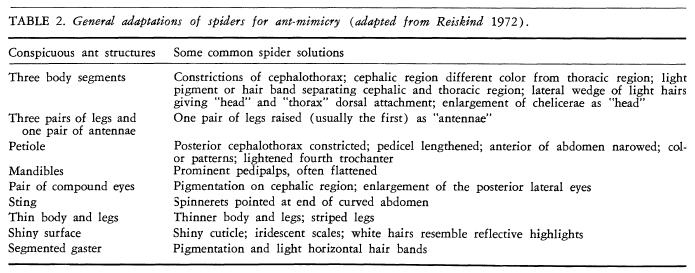
They include a variety of color and body-form modifications that give the spider the appearance of having three body segments instead of two and of having long, narrow legs instead of shorter, more robust legs. Mandibles, compound eyes and even stings are sometimes mimicked by the spiders through modifications in the chelicerae, pigmentation in the cuticle, or special positioning of the spinnerets. In many cases, the extent to which the mimics resemble a particular model is extraordinary
The following table helps in dispelling the notion that this ant resemblance is just a fantasy of the observer.
There are many species of invertebrates that have evolved to resemble ants including crickets, bugs, beetles, springtails, and even flies. At least 100 species of spiders of 12 families mimic ants. The formal name for this phenomenon is ant mimicry or myrmecomorphy. But why would a spider evolve to look like an ant? A few spiders resembles ants in order to get close to them and eat them (aggressive mimicry), but most ant mimic spiders benefit because visual predators take them for ants, and avoid eating them. This is a case of protective or Batesian mimicry, the mimic imitating a dangerous model. Ants can be distasteful or aggressive or both, with biting jaws, a spray of formic acid and a sting. Given that the deception is visual the selective agent must be highly visual: birds, wasps, hunter spiders that normally avoid ants would avoid an ant mimic in the same way, therefore a small spider may have much to gain from resembling a common local ant. My little ant-spider is most likely Micaria pulicaria, a widespread species in the U.K. often found running in the company of common garden ants. It is not reported that it preys on ants so, the reason for its ant mimicry, most likely involves Batesian mimicry. Interestingly, it is the only diurnal genus in a mostly nocturnal hunter spider family - Gnaphosidae, for an example see this post - and ant mimicry might have help this spider lineage conquer and diversify in a diurnal niche.
References Cushing, P. (1997). Myrmecomorphy and Myrmecophily in Spiders: A Review. The Florida Entomologist, 80 (2) DOI: 10.2307/3495552
Reiskind, J. (1977). Ant-Mimicry in Panamanian Clubionid and Salticid Spiders. (Araneae: Clubionidae, Salticidae) Biotropica, 9 (1) DOI: 10.2307/2387854