Tuesday, 29 March 2011

Three more spiders on a white background


Yesterday I tried unsuccessfully to remove a dead Agave from its pot. The dried, brown rosette of leaves made a great winter refuge for many bugs. I have already talked about the hibernating ladybirds that spent the winter in it but yesterday a clutter of spiders (apparently that is the group name!) and some woodlice started to disperse in all directions once disturbed. I knew there was a sac spider living there, but I hadn't managed to get a shot. It is Clubiona corticalis (above), distinguished by its characteristic abdominal pattern. The second spider, Stemonyphantes lineatus, I had never seen before, and its abdomen is pinkish with fine lines and spots. I wasn't expecting to identify them by just browsing the illustrations at a couple of spider guides. I own The Country Life Guide of Spiders of Britain and Northen Europe by Dick Jones and the Collins Field Guide Spiders by Michael Roberts. I double checked it in one of my favourite spider websites eurospiders, with brilliant macro shots. The third spider is the Amaurobius male living in my mop with a true clutter of Dysdera.
Stemonyphantes lineatus
A male Amaurobius similis

Saturday, 26 March 2011

Spider breakfast bowl encounter

This morning I was getting ready to mop the kitchen when a I noticed a recently dead spider under the mop, a female Dysdera crocata. I thought I had just squished it inadvertently, left it aside for later photos, and filled the bucket. A I lifted the mop again, two spiders fell out of it, an Amaurobius and a female Dysdera. I got a couple of drinking glasses and put them over the spiders and started mopping. Up to then I was only a bit surprised by the attractiveness of this old mop for spiders but little else. I moved to the next room while mopping the floor and... yes, you guessed it! another spider fell out of the mop (number 4!) this time a male D. crocata, looking positively angry, lifting his front legs and fangs open! I grabbed another glass and card to fetch him and proceeded to shake the mop thoroughly. Number 5, a small, this one dead, but in good condition otherwise D. crocata fell out. I couldn't carry on with the mopping. I had three live spiders under glass including two adult male and female Dysderas. I had to stage an encounter between them, a breakfast bowl encounter. It was tricky, as they were warm and easily climbed out of the bowl several times, but I finally managed to put both spiders on the bowl under a glass and they settled. The male was only slightly smaller than the female. I slightly touched the male with the glass and he made contact with the female. As a lighting strike, they lifted their front legs and opened their chelicerae to the maximum and faced each other. I lifted the glass carefully and watched. The spiders stood their ground and wrestled with their fangs opened. After a few moments, the female retreated and the male run away. What were so many spiders doing in the mop? Is this a particularly good hiding place in the outside toilet? is it the mating season? or they are part of the same brood that have become trapped in the toilet. I doubt the later as the spiders are good climbing even glass and the window is always slightly open. The spiders did not seem very keen to mate. I wonder, as there are many woodlice in the outside toilet and it might be that these spiders are not territorial and are just exploiting it as the perfect hunting grounds. This post is a very strange end for a kitchen mopping session!
The spiders before I removed the glass

Sizing up their fangs

Friday, 25 March 2011

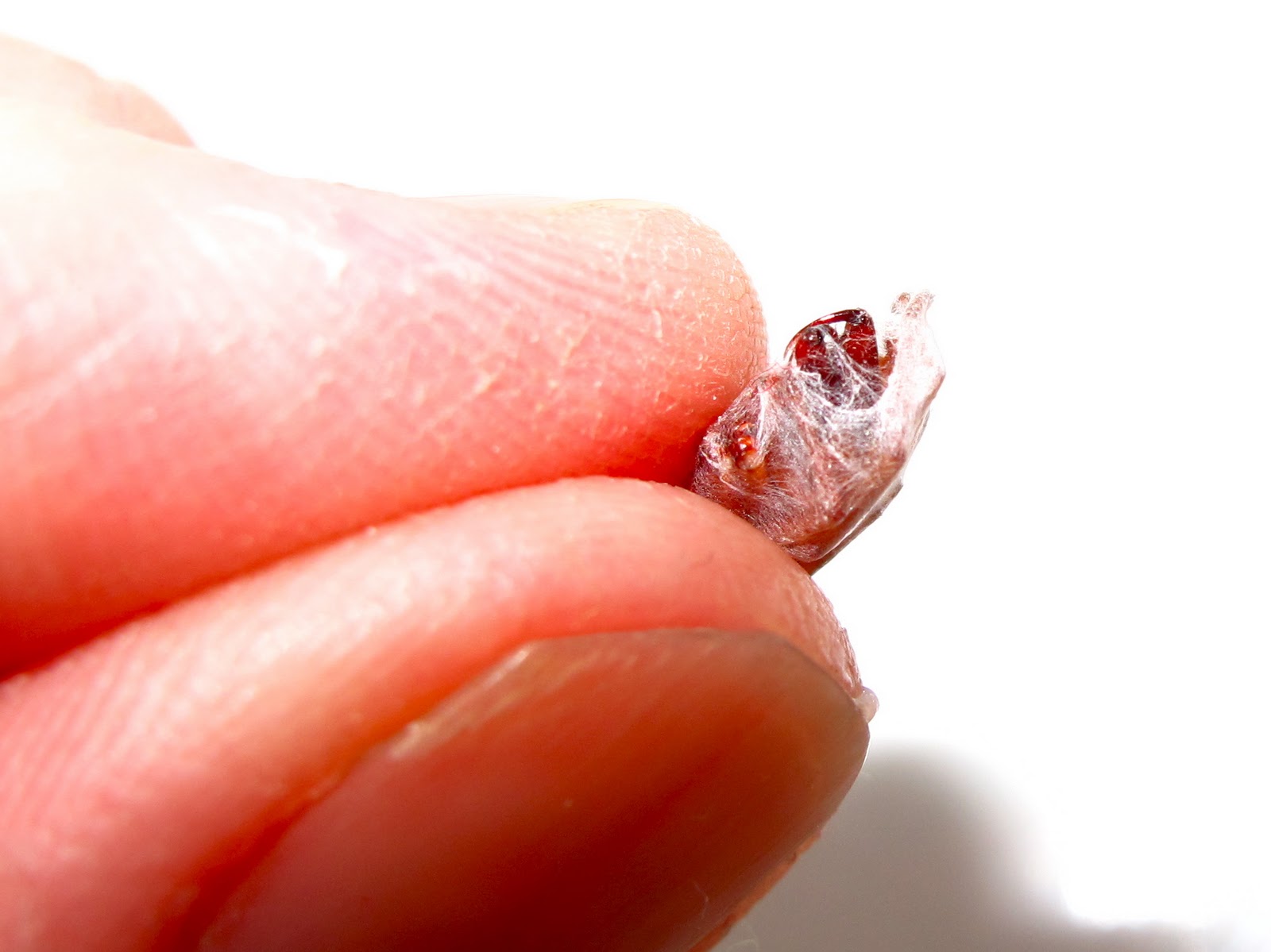
Pholcus 1, Dysdera 0

I mentioned the other day that the Pholcus in my outside toilet was holding a wrapped spider and was looking considerably fatter (above). The following day, I picked from the floor the remains of her prey, which she had dropped. I was shocked to find it was a fearsome Dysdera, the woodlice hunting spider. I tried to unwrap it to get a better shot, but it was difficult. Fortunately, the fangs stuck out. I don't think there is any other British spider with such long fangs and chelicers of red colour. These flimsy spiders make good bets for spider battles!
click to embiggen

Thursday, 24 March 2011

The Tawny Mining Bee

We've enjoyed a few really warm days this week. Bumblebee queens have come out of their winter refuges and are bumbling about looking for nesting sites and feeding on early flowers. Spring bees have also started to emerge, and one of the most striking, the Tawny Mining Bee, Andrena fulva, has also done so. I came across this fresh female flying about and finally settling on the leaf litter to bask. Females are covered on dense and bright orangey-red hairs, contrasting with their black heads and legs. The one below was sunbathing on the bird table in April last year after collecting some cherry pollen. As other Andrena species, females carry pollen in hair brushes on their back legs.
Males are so very different, slimmer, with a large white moustache and more obvious jaws:
This bee flies in a single generation, from late March to late May. The peak flight season on the Tawny Mining bee, April, coincides with flowering times of fruit trees and they can often be seen feeding on them, and contribute to their pollination. They use a diversity of other flowers, including blackthorn, broom and willow.
 The Tawny Mining bee nests in bare patches of ground on grassy areas and therefore is known to nest in gardens and parks. Nesting aggregations, in which many bees nest in the same area, can be quite large and the ground is the peppered with miniature volcanoes of loose soil around the nest entrance which they have dug out while they dig the nest. Despite them nesting near each other, the mining bees are solitary and each female digs her own nest and collects nectar and pollen for her own young. I will keep an eye for their nests, the next few weeks, and see if I can catch them as they come and go from their little volcanoes.

Monday, 21 March 2011

Spring gallery

It has been quite warm today, 18.5 oC! A great day to start spring, the garden was buzzing and there was a lot of "firsts" of the year. One of those days it is hard to choose what to blog about. I saw my first butterflies of the year, a Red Admiral Peacock (in flight), a Small Tortoiseshell feeding on willow and a male Brimstone; first queen wasp; first pair of 7 spots mating and my first photo of a ladybird taking off. Also, first Bombus hypnorum, B. hortorum and first female Anthophora plumipes. The following shots are the best of the day.
A fortunate consequence of 7 spot ladybird communal hibernation is that you don't have to look far for a partner when you wake up!
A groggy queen wasp landed on yellow plastic 
And a hyperparasitoid flightless wasp, possibly Gelis sp. which looks rather like an ant walks on the blue bin
Philodromus spider sunbathing 
The first female Anthophora plumipes leaves a daffodil, which has marked her back with yellow pollen 
A male A. plumipes briefly resting on a buddleia trunk. Males look velvety this early in the year. They have been patrolling the garden since the 11th of March
 A Pholcus spider on the outside toilet looks much fatter than yesterday, after enjoying her spiderly meal.
A Harlequin and a 7 spot look like they are playing peek-a-boo
B. hortorum visiting Hyacinths