Saturday, 9 April 2011

A spider in ant disguise

ResearchBlogging.orgMy young daughter does not like ants. This is a bit troublesome at this time of the year when garden ants are everyhwere. Yesterday, she pointed at something on the ground. I looked at I saw what looked like an ant carrying another ant running very fast. It must have looked a bit odd as I stopped the "ant" putting my hand in front of it. She hid underneath and I slowly lifted my hand and took a couple of shots. Only when revising the shots did I realised that the ant was only an illusion: it was a spider, but one that strongly resembles an ant not only in size, general shape, shininess, but also in posture and behaviour. She carried her front legs raised so that it looks like its got antennae and six legs, and its movements were most reminiscent of the manic running of ants in hot weather.
In her review of ant mimicry in spiders Paula Cushing stated referring to morphological spider modifications to resemble ants:

They include a variety of color and body-form modifications that give the spider the appearance of having three body segments instead of two and of having long, narrow legs instead of shorter, more robust legs. Mandibles, compound eyes and even stings are sometimes mimicked by the spiders through modifications in the chelicerae, pigmentation in the cuticle, or special positioning of the spinnerets. In many cases, the extent to which the mimics resemble a particular model is extraordinary
The following table helps in dispelling the notion that this ant resemblance is just a fantasy of the observer.
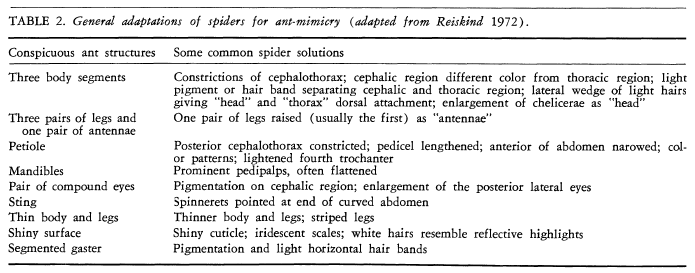
There are many species of invertebrates that have evolved to resemble ants including crickets, bugs, beetles, springtails, and even flies. At least 100 species of spiders of 12 families mimic ants. The formal name for this phenomenon is ant mimicry or myrmecomorphy. But why would a spider evolve to look like an ant? A few spiders resembles ants in order to get close to them and eat them (aggressive mimicry), but most ant mimic spiders benefit because visual predators take them for ants, and avoid eating them. This is a case of protective or Batesian mimicry, the mimic imitating a dangerous model. Ants can be distasteful or aggressive or both, with biting jaws, a spray of formic acid and a sting. Given that the deception is visual the selective agent must be highly visual: birds, wasps, hunter spiders that normally avoid ants would avoid an ant mimic in the same way, therefore a small spider may have much to gain from resembling a common local ant. My little ant-spider is most likely Micaria pulicaria, a widespread species in the U.K. often found running in the company of common garden ants. It is not reported that it preys on ants so, the reason for its ant mimicry, most likely involves Batesian mimicry. Interestingly, it is the only diurnal genus in a mostly nocturnal hunter spider family - Gnaphosidae, for an example see this post - and ant mimicry might have help this spider lineage conquer and diversify in a diurnal niche.

References
Cushing, P. (1997). Myrmecomorphy and Myrmecophily in Spiders: A Review. The Florida Entomologist, 80 (2) DOI: 10.2307/3495552
Reiskind, J. (1977). Ant-Mimicry in Panamanian Clubionid and Salticid Spiders. (Araneae: Clubionidae, Salticidae) Biotropica, 9 (1) DOI: 10.2307/2387854

Wednesday, 6 April 2011

Fascinating jumping spiders

ResearchBlogging.orgWe had a very warm day today - for April - the sun hit the brick walls and this is something that brings jumping spiders out. I spot one on the wall, quite high up, she moves in a typical jerkily fashion on to a wooden plank and I take a few shots with my arms outstretched and a poor view of the LCD display, but I am happy when manage a few focused front shots (above). I think this is Salticus cingulatus, a close relative of the zebra jumping spider, Salticus scenicus. Jumping spiders, or salticidae - the family latin name - are the largest spider family, with 5,000 species. They have a highly acute visual sense, with their large and forward facing antero-median being responsible for the visual acuity, and the remaining 6 eyes - with the posterior pair facing almost backwards - acting as motion detectors. Although the external lenses are fixed, the internal eye tube can move to precisely look towards an object. Some species have been shown to have colour and UV vision (tetrachromatic vision) and correspondingly, jumping spiders include some of the most colourful spiders. Their mating rituals are mesmerising: they include synchronic front leg movements, abdomen vibrations and percussion, yes, percussion! They remind me of flamenco dancers with their tap shoes and castanets. Something that cannot be imagined and have to be seen:


I often come across feeding jumping spiders. Then they are preoccupied and they are much easier to approach. This male S. scenicus had caught a fly and came to inspect me, before returning to its oversized prey.
The following one, a tiny, possibly immature specimen still poorly marked, was preying on an aphid in my conservatory bougainvillea.
Jumping spider are extremely agile and their hunting has been compared to a cat stalking its prey. First the spider moves its "head" fixing its eyes on the potential prey, then the abdomen is aligned and then the spider moves slowly towards prey. When the prey is within jumping distance, the spider ties a line of silk to the substrate and pounces on the prey. Surprisingly, jumping spiders can detour when jumping, and approach does not need to be in a straight line, with the spider losing sight of prey in occasions, suggesting remarkable planning for a tiny invertebrate. Salticids show a range of predatory strategies from extreme sit-and-wait species which only move to jump into passing prey to specialist ant predators, to cleptoparasitic species, which specialise in robbing spider webs or deceptive prey-mimics, who imitate the movement of prey that has fallen on a web to lure the spider out and the eating the spiders themselves. There is even a herbivorous jumping spider, the just so named Bagheera kiplingii, from Mexico, which exploits an ant-acacia mutualism, mainly  feeding on specialised leaf tips produced by the acacia for its mutualistic ant, and nectar, complementing its diet with a few ant larvae. What amazing animals they are.

References
Richman, David B., & Jackson, Robert R. (1992). A review of the ethology of jumping spiders Bulletin of the British Arachnological Society, 9 (2), 33-37

Meehan CJ, Olson EJ, Reudink MW, Kyser TK, & Curry RL (2009). Herbivory in a spider through exploitation of an ant-plant mutualism. Current biology : CB, 19 (19) PMID: 19825348

Tuesday, 5 April 2011

Tawny mining bee nesting aggregations

ResearchBlogging.orgI have been posting on the Tawny Mining Bees, Andrena fulva, recently. I have been watching suitable nesting sites for signs of activity and today I came across many nests located in groups in several grassy areas. It was a bit windy and the female bees often missed their nests when landing. Instead of walking the short distance, they would fly again, carry out what looked like a positioning flight, and landed on top of their nest mound and got inside.
 Some females seemed to be looking for good places to nest, and tentatively would start digging in the soil amongst other nests.
Males were patrolling around, jumping on passing females. Tawny Mining Bees, like many other bees and wasps, tend to nest in clusters, many nests will be located near each other, when apparently suitable habitat is plentiful around them. They like areas of short grass and the fresh pellets of soil soon stick out like mini mole hills on lawns, verges and park greens.
 Why do bees nest in this way? They are solitary, so each bee will make her own cells and storage pollen and nectar toward her eggs. Apparently bees are able to detect the smell of conspecific active nests and preferable fly towards them; they also tend to return to their natal sites, and, obviously, successful nesting areas would tend to increase their nest density with time. These are proximate explanations, they tell us how bees actually find the nesting sites. But do bees actually benefit from nesting in an aggregation as opposed to doing it on their own? Aggregated nests must have a strong benefit to counteract the costs associated to the behaviour, such as increased competition or higher diseased transmission. Five hypothesis as to the adaptive value of nesting aggregations have been put forward:
1) Bees might be selecting very specific environmental conditions to locate their nests, for example, soil of a particular consistency or nectar sources nearby. This hypothesis has been investigated and appears to hold for some species, but not for others.
2) Nest sites might act as "information centres", where bees would find from others where the best foraging resources where. This, although possible, has no empirical support.
3) Newly nesting individuals might nest in aggregations because they act as markers of successful nesting sites.
4) Bees might benefit from reusing old nests, so that some of the costs of digging would be offset.
5) Nesting communally might offer some antipredator or antiparasite benefits, maybe by confusing predators, or communal defence. Data in support of this hypothesis is conflicting: parasites can either favour aggregations, by being more effective the less aggregated bees are, or dispersed nesting, when they locate clumped nests more effectively. Some bees gain protection from parasites by nesting communally, for example, as I covered in the recent post on Melecta, individuals of the host species Anthophora attack parasites near their nest, therefore conferring some protection to neighbouring nests.
Whatever the reasons, Andrena fulva nesting aggregations must be one of the easiest to observe in British solitary bees. Just look for their little molehills on the grass. A little red head might be peeking from inside.

References
Michener, Charles D. (1974). The social behavior of the bees: a comparative study. Harvard University Press. Other: ISBN-13: 978-0674811751
Rosenheim, Jay A. (1990). Density dependent parasitism and evolution of aggregated nesting in the solitary Hymenoptera Annals of the Entomological Society of America, 83 (3), 277-286

Monday, 4 April 2011

Ground Crab Spider

ResearchBlogging.orgUntil a couple of weeks ago, I was under the mistaken impression that there were no crab spiders in the north of the U.K. Although this is true for flower crab spider, Misumena vatia, a chamaleon-like hunter that changes colour to match the flower is sitting on, there are many other species that are widely distributed, in the U.K. as I found out through a thread in Wild About Britain. All crab spiders have some ability to change colour to match their surroundings and become invisible to their unsuspecting prey. They do not build a web to hunt, instead, they rely on their superb camouflage and their front two pairs of legs, larger than the rest and furnished with forward facing spines, which they keep open when hunting, forming like a living trap. Their's is a stalking strategy, sitting with its outstretched legs waiting for invertebrates to turn up. The name crab spiders suits them well, as their oversized front legs, divergent lateral eyes and sideway walking makes them look like miniature crabs. One of the most widespread crab spider is Xysticus cristatus. This crab spider is found on the ground or on low vegetation, although it can also hunt in flowers. The female above was sunbathing on my conservatory frame on an awkward corner for photos. I captured it and took a few shots in the while bowl. I released it on a dandelion (above) - before I found out about its preferred hunting grounds - but she didn't like it and scuttled away relatively quickly.
Xysticus cristatus female on her crab-like stance
Unlike flower crab spiders, which feed mainly on pollinators - bees, hoverflies and butterflies - ground crab spiders feed on a wide range of prey, from small prey such as ants aphids and springtails to the larger bees and butterflies, and other spider species, even earthworms! (see Figure below from Nyffeler & Breene). Birkhoffer and coleagues found that Xysticus cristatus - together with wolf spiders - eat larger proportions of aphids when compared to web building spiders. Their common aphid prey might make them a suitable biological control, retarding the population growth of aphids during spring so the authors suggested to encourage habitats favourable to these spiders near crops.
References
Nyffeler, M., & Breene, R. (1990). Spiders associated with selected European hay meadows, and the effects of habitat disturbance, with the predation ecology of the crab spiders, Xysticus spp. (Araneae, Thomisidae) Journal of Applied Entomology, 110 (1-5), 149-159 DOI: 10.1111/j.1439-0418.1990.tb00108.x
Birkhofer K, Gavish-Regev E, Endlweber K, Lubin YD, von Berg K, Wise DH, & Scheu S (2008). Cursorial spiders retard initial aphid population growth at low densities in winter wheat. Bulletin of entomological research, 98 (3), 249-55 PMID: 18439342

Saturday, 2 April 2011

Melecta, a cleptoparasitic bee

The plum tree started flowering last week and today it was buzzing with bees. I counted six species, Bombus terrestris and lapidarius queens, Anthophora plumipes males and females, Andrena fulva, with males actively patrolling the branches, and the first males Osmia rufa of the year. Later, a black bee with white and grey hair patches and dark wings turned up. It was Melecta albifrons, a cleptoparasite of A. plumipes. I haven't found much information on M. albifrons so the following life history account mainly comes from a study on the American species, Melecta separataMelecta females parasitise Anthophora species that nest communally. They explore their host's nesting aggregations in search of finished nests. A female, upon finding a nest will start digging and breaking open the sealed entrance. Then she will lay an egg on the roof of the cell, seal the cell and replug the nest. Anthophora females usually attack the cuckoo bee, but she either flies away or if inside the nest it defends herself with her sting. The Melecta larva hatches a day earlier than the Anthophora's and is very mobile. They pierce and drain the Anthophora egg and any other Melecta eggs that she finds in the cell with their long sickle-shaped mandibles. Only one Melecta larvae survives, as if two are born at the same time one will kill the other. The larvae then feeds on the syrupy mixture of pollen and nectar intended for the Anthophora larvae. Subsequent larval stages lack the long mandibles of the first stage. The following year a Melecta will emerge from the cell, having consumed the food intended for Anthophora grubs. In a M. separata nesting aggregation 20% of the nests were parasitized.
The Melecta albifrons visiting my plum showed a very different behaviour from other bees, sluggish, like she didn't want to fly too much, climbing over the flowers to reach each of them and feeding showing a very long tongue. The bee stayed for quite a while feeding on the plum flowers. M. albifrons has a very similar distribution to its host in Britain (click here for distribution map), reaching up to the Yorkshire Wolds in the north. Its peak flight period is a few weeks after the emergence of the host, and flies from April to early June. Given that it doesn't need to collect pollen for provisioning its brood, the bee is not fussy about what flowers to visit, and tends to fly at short daily periods - the warmest - as they are less endothermic than their Anthophora hosts, as shown in the figure below.
References
Thorp, R. (1969). Ecology and Behavior of Melecta separata callura (Hymenoptera: Anthophoridae). American Midland Naturalist, 82 (2) DOI: 10.2307/2423782
P. G. Willmer and G. N. Stone (2004). Behavioral, Ecological, and Physiological Determinants of the Activity Patterns of Bees. Advances in the Study of Behavior, 34 , 347-466 : doi:10.1016/S0065-3454(04)34009-X