Sunday, 11 April 2010

The soil dwelling 'eightypedes'

When collecting some compost that had formed on the concrete under a large vine, I came across half a dozen subterranean centipedes. Despite having no eyes, they appear annoyed when exposed and try and hide under the soil as fast as they can, with their antenna moving very fast feeling the way. They are slower than the Lithobius, but their long snake-like bodies makes it quite tricky to get good shots, so I was quite pleased with the one above. This is Stigmatogaster subterranea (previously known as Haplophilus subterraneus), which usually has between 77 and 83 pairs of legs. I counted about 80 on a photo, a bit short of a hundred to deserve the name 'centipede' - which anyway, no centipede has, as they always have an odd number of pairs of legs - but still a respectable number. This species is blamed for nibbling roots of crops, and it feeds on vegetal and animal matter, but last year I witnessed a titanic struggle of a grub of some sort with an specimen of this centipede just at ground level. You would wonder how on earth did I happen to notice this, and the reason is that I had just seen a queen bumblebee digging into the soil and I wondered if she was going to make a nest and waited patiently watching until the two struggling pair of bugs nearby on the ground catched my attention. The fight carried on for some time but, unfortunately, I do not know how it ended. It just seemed too large a prey for the centipede. The grub moved its body around and the centipede curled around it, and, as you can see in the photos, tried to bite with its fangs. From the photo it appears that either the skin of the grub was too tough or the bite too wide for the fangs to pierce it - and therefore to inject the venom. In any case, it is quite unusual to come across some subterranean bug actually behaving, as opposed to simply disturbing it.
The centipede curling around its catch.
In this photo you can see the darker fangs opened under the centipede head, trying to pierce the grub.
Another shot with fangs.

The common woodlouse

With this photo of a Common Woodlouse (also known as shiny or smooth woodlouse) Oniscus asellus, let me round up the topic of woodlice. Woodlice are crustaceans, a mostly marine group. They have 7 pairs of legs when adults. They are quite gregarious, and usually many individuals are found together. The common woodlouse is not as drought resistant as the rough woodlouse, as their bodies are more permeable to water, and therefore is present in more humid microhabitats. It has a very shiny cuticle with dark and light patches, although colour varies, their antenna are longer than in the rough woodlouse. We found these large individuals (this is the largest UK species and can reach 16 mm in length) today under large logs kept covered with some tiles.
A side view of a different individual.
A front view of the first individual.

Saturday, 10 April 2010

Grape Hyacinth visitors

Many nectar-feeding insects prefer to use abundant floral resources. That is, a plant is much more frequently visited when there is a large clump of the species together or it flowers profusely, just because the insect has to travel less to obtain the same amount of energy. I have experienced this first hand in my garden with Grape Hyacinth (Muscari armeniacum) an early flowering bulb with clusters of deep blue flowers at the top of a spike. This year I have several large drifts of this species, which has been flowering for the last month or so and this has been rewarded by an unusually high diversity in the species visiting the flowers. Here is a selection of photos taken in the last few days on this plant.
Anthophora plumipes female loaded with yellow pollen and feeding on the flowers
Anthophora plumipes male, leaving the flowers with his tongue still extended
A male Red Mason Bee (Osmia rufa) sunbathing on a stone next to a Muscari clump. The first males of the year appeared today and I have watched them feeding and patrolling the plants, making sure they weren't missing any of the females. The males kept checking the Anthophoras.
A Peacock visiting the flowers. Grape hyacinths are also visited by Commas and Small Tortoiseshells (see here for photos)
This scruffy-looking dark bee with white tufts of hair is Melecta albifrons, the cleptoparasite bee (cuckoo bee) of Anthophora plumipes.
I have got no photos but a couple of days ago I saw an Andrena fulva and a queen Bombus pascuorum (both first of the year) visiting Muscari in my garden.
UPDATE 11/04/10
Today a queen Bombus terrestris visited the Muscari patch and I managed to get a shot of the first Osmia rufa of the year feeding on it as well.


UPDATE 17/04/10
A Green-Veined butterfly fed on the Muscari patch.

Friday, 9 April 2010

The common rough woodlouse

Although woodlice have been mentioned in BugBlog a few times, they haven't been the main character in any post yet, and this has to be addressed. This little group I found yesterday under a pot gives me the perfect excuse. There are over 3,000 described species of terrestrial isopods (woodlice) in the world, with only 35 native to the UK. The Common Rough Woodlouse (Porcellio scaber) - above- is one of the most common. Unlike the Pill Woodlouse (Armadilium), it is unable to roll into a ball, and instead, its defence mechanism consists in grasping the substrate and pressing its dorsal armour against it, so that its more vulnerable underside is protected. Its nocturnal habits and love of humid places reflect the fact that it loses water very easily from its body due to transpiration as their surfaces are not waterproof. Woodlice absorb water from their surroundings when they rest under stones, in compost heaps or similar places and they lose it when they forage away from their refuge. They are detritivores and feed on dead vegetable matter and therefore are involved in the decomposition of dead leaves and the production of compost.
 Woodlice usually have separate sexes, that is, there are males and females. Females brood the eggs and their young in their first instar, suplying them with nutrients and water, in a pouch under their body. In the common rough woodlouse, females can produce three broods (of around 20 young) a year in good conditions. Breeding is very seasonal, and starts when days become longer (16 h light). Woodlice can live several years.

More on little pole vaulters

After researching and writing my first post on springtails, I suddenly have become much more aware of these tiny bugs. Yesterday in the garden, I came across quite a few. Something I didn't mention is that springtails can be very colourful. Once I cropped some of my pictures - I am working on the edge of the resolution on my Powershot G10 camera - the patterns on the abdomen of this tiny, oddly shaped, and appropriately named Dicyrtomina ornata appeared as quite striking. Found when lifting the plastic lid of a sandpit.
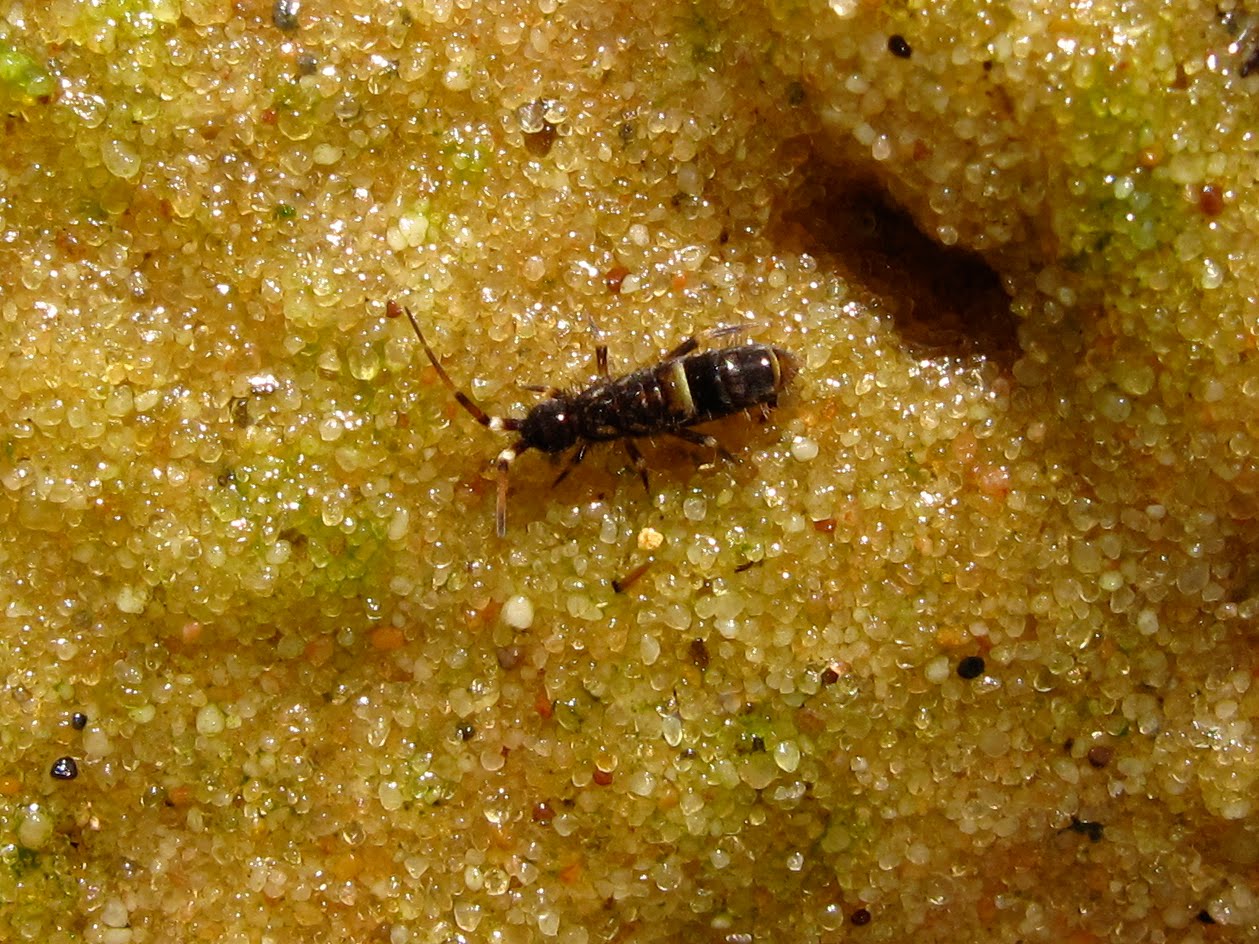
I also came across a relative of the maned species I found in the conservatory; although hairy, this one has clear bands in the abdomen, and also banded antennae. I think it is Orchesella cincta.
The sand grains gives an idea of scale. 
Some springtails had fallen on a little puddle and died. This one shows the little 'pole' they use for jumping extended behind its abdomen. Normally, the mechanism is tucked under their body. I made one springtail jump just to see the level of control they have on where they land and the direction. They seem to jump 'forward' most of the time, but the length of the jumps varied quite a lot.
Finally, this is the tiniest springtail I've seen. Less than 2 mm in length, maybe just 1 mm. I do not know what species it is. I found it under a bonsai pot.

More information
This page has identification and distribution information on UK springtails.